In the latest Curmudgeon’s Corner Sam and Ivan talk about:
Recorded on 7 Oct 2012 Length this week – 1:01:53 |
 |
|||||
|
||||||
|
In terms of the categories I use to classify states based on the average of the last five polls, today was another brutal day for Obama. It just keeps getting worse. There had been some talk about the “bump” from the debate having bottomed. I’m just not quite seeing it yet. One state does move in Obama’s direction today, and I’ll get to that, but for the most part the theme today is states that had once looked pretty safe for Obama now once again looking competitive. So lets look at the states, from smallest to largest in the electoral college:
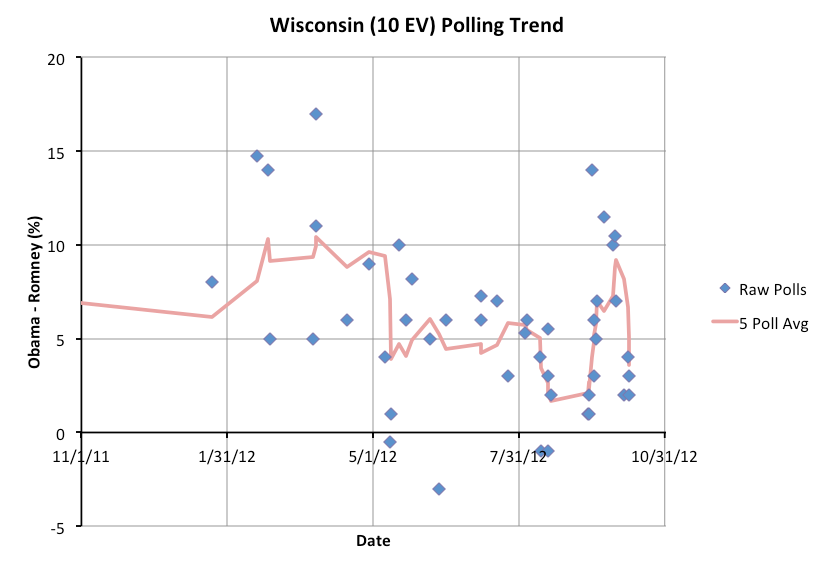
Immediately before the debate, Obama’s lead in Wisconsin stood at 9.2%. As of today’s update, it has dropped to a 3.6% lead with 4/5 polls now from after the debate. Huge drop. This of course puts Wisconsin back in “Lean Obama” territory, meaning Obama is ahead, but by a small enough margin it is easy to imagine Romney taking the state. Wisconsin has been in this category before of course. But it is a big change from the time period right before the debate.
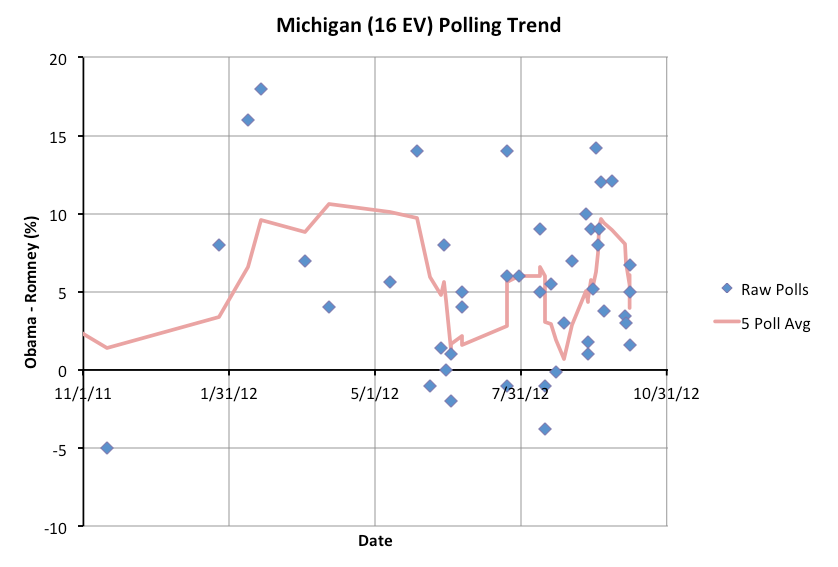
Michigan looks pretty similar to Wisconsin. Right before the debate Obama had a 9.0% lead. Now he has a 4.0% lead with all five polls in the average after the debate. So Michigan also returns to “Lean Obama” and I include a win here in Romney’s best case.
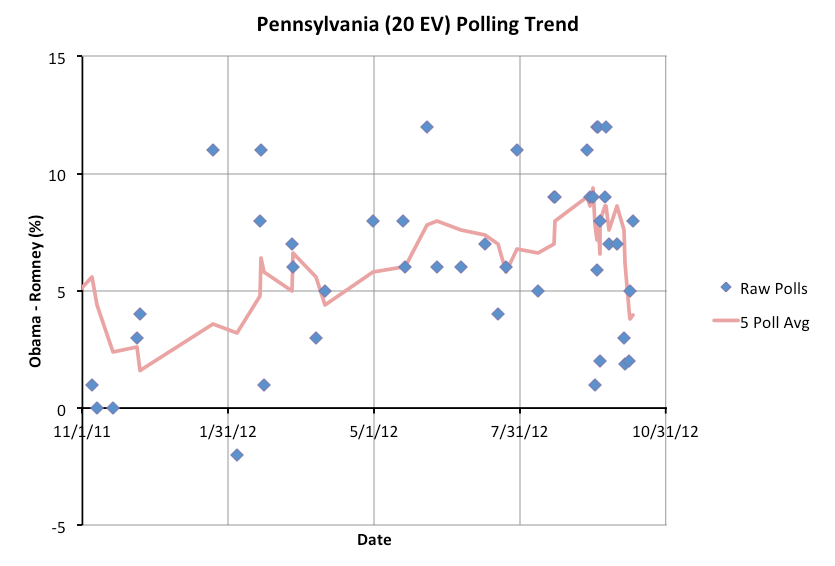
Does the pattern look familiar? Before the debates, Obama had a 8.6% lead in Pennsylvania. Now with all five polls in the average after the debate, Obama’s lead is down to 4.0%. So Pennsylvania also comes within reach for Romney. Yes, he is still behind. In all three of these states. But they are all close. Another bad new cycle for Obama, and seeing these states move over to Romney does not seem impossible.
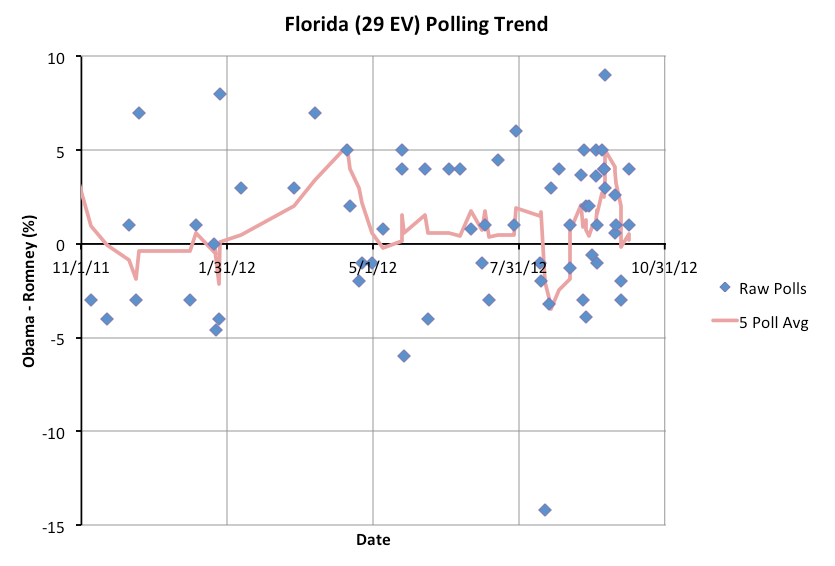
The one move toward Obama today is the biggest state moving today, but Obama folks should not get too excited. The five poll average for Florida moves from a 0.2% Romney lead yesterday to a 0.2% Obama lead today. Those margins are negligible. Either way, Florida is incredibly close and could very easily go either way. Before the debates Obama had a 3.2% lead in Florida, so his drop has not been as large here as elsewhere. But in a state this big and this close, every little bit counts. Florida is hyper close, but I have to classify it somewhere, and for the moment, for today, it goes back into the Obama column, where it has been most of the year. Just barely. Which brings us to the new summary of the race:
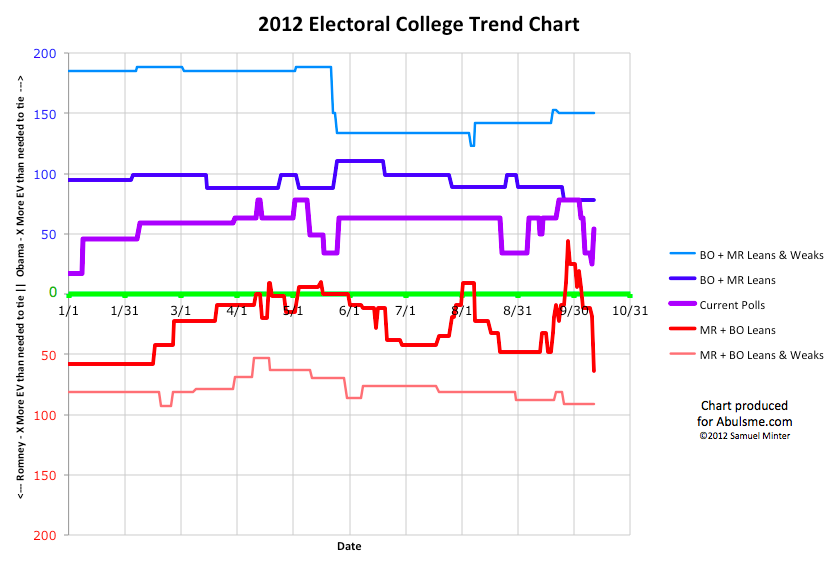
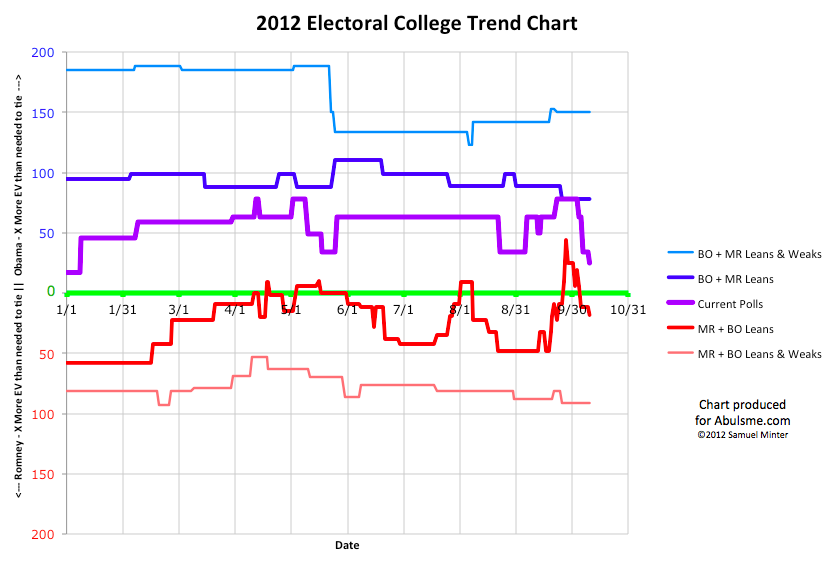
Romney’s best case is better than it has been all year. He beats his post-primary peak from the beginning of September, and he even passes all time peak from January. Obama’s lead in state after state has just been washed away in the aftermath of the first debate. Obama is still ahead in these states for the most part… but what once had been substantial leads are now very narrow. This is clearly not where Obama wanted to be right now. Now, the current status does improve for Obama compared to yesterday because of Florida flipping categories, but as I mentioned above, the margin in Florida is essentially zero. So the difference between today and yesterday isn’t really substantive on that front. Either way, Florida is a toss up at the moment. So to try to get a little more insight, although I won’t do this every time, lets once again look at the actual current margins in all of the close states to see how they rank. With just the states he is ahead in by more than 5%, Romney starts out with 191 electoral votes. From there Romney needs 78 more electoral votes to tie, 79 to win. Ranked in order of current polling, these are the current “close” states:
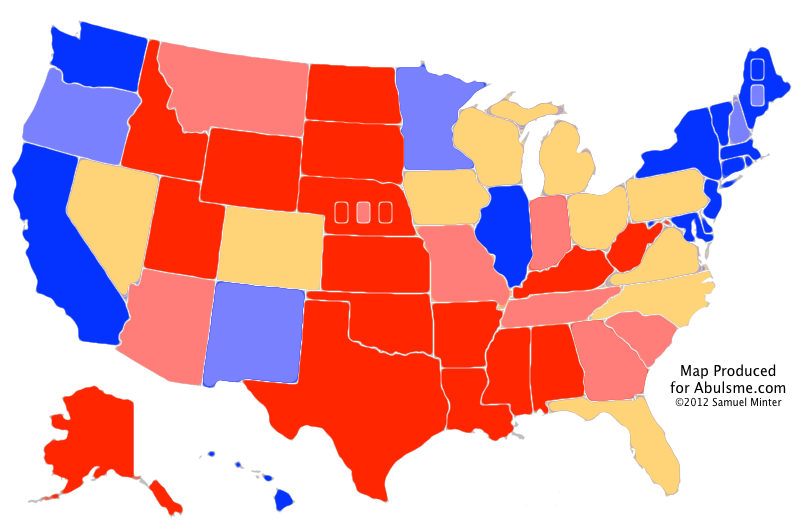
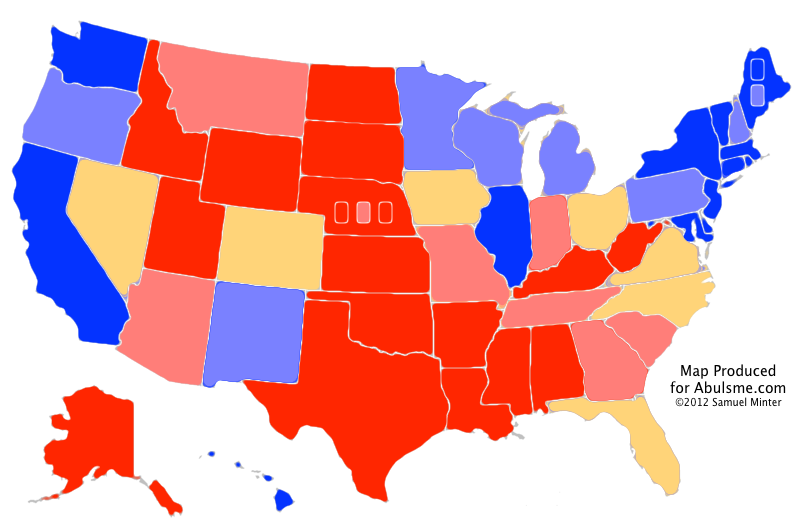
That is a lot of “close” states. Before the debate, we were down to just a handful of close states. No more. Anyway, if Romney pulls those states toward him “evenly” then a move of just over 2.2% more in his direction would get him all the states through Virginia on the list above, which would give him an over all win. Obama is still ahead. It is worth repeating that. But this race is so much closer than it was before the first debate. And Romney has so many more “paths to victory”. The easiest route is though Florida, Ohio and Virginia. But there are now many more options available as well. Are we now at a ceiling for Romney though? Has he picked up about all of the “persuadable” votes that he can? Is there really headroom to move higher? If not, then it still isn’t enough. Obama will win. If the Obama folks screw up more, and the Romney folks effectively capitalize on it though… then maybe Romney ends up with more room to go up further. The next event expected to have the potential to move numbers is of course the Vice Presidential debate… a few hours from the time I am posting this update. We probably won’t really start seeing any move from that debate in the state polls for a few days, but this is probably one of the last moments we’ll really be able to look at the poll numbers and attribute the motion directly to the first debate. Starting with the VP debate, things get more muddled again, and more factors are at play. But looking at things right now, it is clear that the debate had a devastating short term effect. It was NOT enough to put Romney in the lead when you look at the electoral college. But it was enough to take what looked like an insurmountable lead for Obama and turn it into a tight race. The big question now is does it stay a close race, or does Obama start to claw back his previous lead. Or… of course the third option… does Romney/Ryan score some more big blows and actually start taking the lead in this race. Note: Chart and map from the Abulsme.com 2012 Electoral College Prediction page. Both assume Obama vs Romney with no strong third party candidate and show polling as it currently exists. Things will change before election day. On the map red is Romney, blue is Obama, gold states are too close to call. Lines on the chart represent how many more electoral votes a candidate would have than is needed to tie under several different scenarios. Up is good for Obama, Down is good for Romney.
Two states changing status today, and both are bad news for Obama. Lets get right to it:
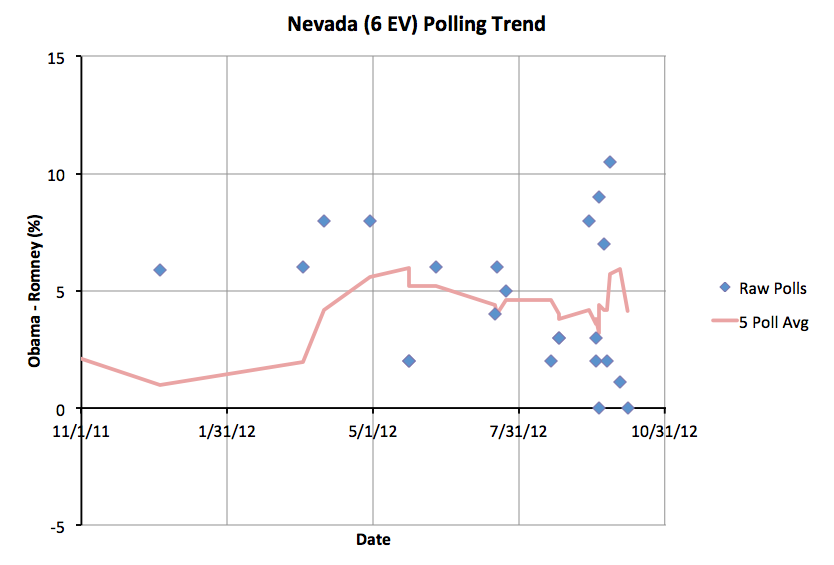
Prior to the debate last week, Obama’s lead in the five poll average in Nevada was 5.9%, which was a substantial enough lead for Obama that Nevada was not in the list of states that were within reach for Romney. We now have the first post-debate poll, and it shows a tied race in the state. This is just one poll out of five, but it causes the five poll average to drop to a 4.1% Obama lead. So once again I list Nevada as just “Lean Obama” and it contributes to Romney’s best case. Although it is a drop from where the state was before the debate, “Lean Obama” is actually where Nevada has been most of the last year, so to some degree this is reversion to the mean. Obama had a bunch of strong polls in September, but those are now in the rear view mirror, replaced by the worst numbers he has had in the state all year. (It is important to point out that some of these bad numbers were from polls taken BEFORE the debate.) The five poll average is still buoyed by some strong late September polls. Unless Obama gets a quick bounce back in the next few polls, I expect Obama’s lead in Colorado will diminish further as those polls age off.
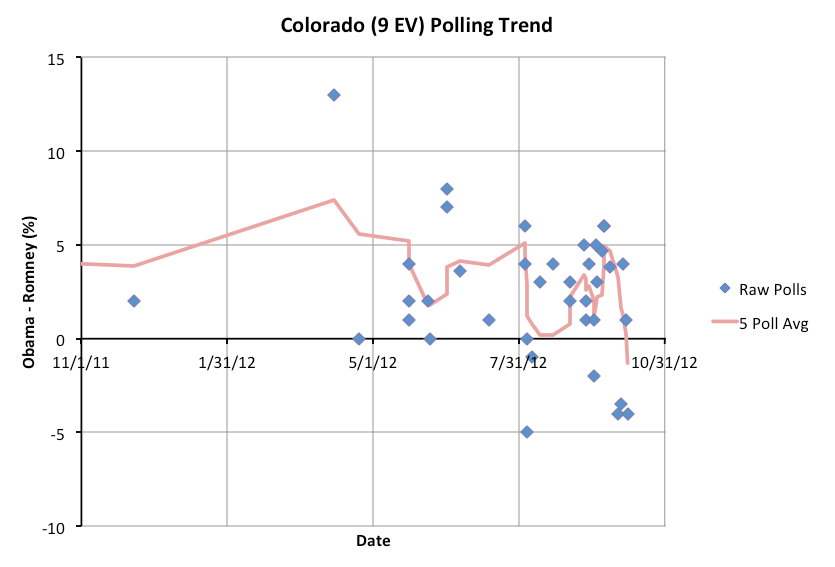
In Colorado before the debate Obama was 3.3% ahead in the five poll average. There have now been four polls that ended after the debate and the state flips to a 1.3% Romney lead. This is the first time in the last year that Romney has been in the lead in Colorado according to the five poll average. Unlike Nevada, where the state was down from a spike toward Obama, but had so far only returned to well traveled territory, in this case Romney is breaking new ground. Romney adds what had been a narrow but consistent Obama state to his column. So, the new summary:
Before any discussion, time to eat some crow. On September 6th I said:
So what is the comparison between now and the beginning of September?
Well, OK. I never specified how exactly to judge this, but two out of three of the lines being better than they were seems like it should qualify, especially since one of them is the “current” line. By that mark, Romney is now at the best point he has been since the very beginning of January. To be fair to myself, from that moment onward, in almost every update, I did mention that there was one way for Romney to come back again, and that was for Obama to majorly screw up. I perhaps stated this most clearly in my update from September 27th, which turned out to be Obama’s peak:
If you believe the most hyperventilating reports out there, a catastrophic Obama implosion is indeed what seems to have happened at the first debate. It seems it was not as unlikely as I expected. I presumed both Obama and Romney would put in not great but competent debate performances and the net effect would be essentially zero. Instead we saw a brand new Romney, hitting his stride in a way he never had in the previous year, and an Obama who looked like he didn’t want to be there and was phoning it in at best. Although Obama peaked before the debate, as each post-debate poll comes in, what a couple of weeks ago seemed like an insurmountable lead for Obama is getting transformed into a genuinely close race. A number of people doing detailed analyses of the polls have pointed out that if you look carefully at the dates on both state and national polls, there is tentative evidence that Romney’s debate bounce may have already peaked and is now starting to recede. So this may be a good time to do another detailed look at where the swing states stand, and what it would take for Romney to win. First thing to point out… despite the fairly significant drop Obama has seen since his peak… he is still ahead! (For the moment anyway.) Some national polling averages now show Romney ahead in the popular vote, but remember we do not have a national election, we have 51 smaller elections. Looking at the states using my five poll average, here is where we now stand, looking not just at my categories, but also specifically at the magnitude of the candidate leads in the close states. With only the states where Romney is ahead by more than 5%, Romney gets to 191 electoral votes. Then we add in the close states where he is ahead:
That gets Romney to 244 electoral votes if he can hold his lead in those three states. You need 269 electoral votes to tie (a situation Romney would probably win in the house) or 270 electoral votes to win outright. So Romney needs 25 more electoral votes to tie, 26 to win. To get there he needs to start pulling ahead in states where Obama is currently ahead.
There are a number of combinations that will get Romney to 270, and any of those four close states could easily flip. They are all close enough that the lead can disappear overnight. With the current state of the polls though, the easiest way for Romney to win seems to be to flip Ohio and Virginia, both of which are now looking exceptionally close. Prior to the debate, Obama had a 7.8% lead in Ohio… now down to 0.4%. That is a massive move in such a short time. Prior to the debate, Obama had a 4.3% lead in Virginia, now down to 1.0%. That’s a smaller move, but not insubstantial. If Romney can move each of those just a LITTLE bit further, then it would put him ahead in my “current” electoral college model for the first time ever. For almost all of the last year, while Romney’s best case was to win, I’ve been able to repeatedly say that hitting the best case was difficult. Romney would have to almost sweep the close states, and during most of that time, Romney was behind in most of those close states. It was a tall order. Not so much any more. Romney is still behind. But both Ohio and Virginia are in easy spitting distance. A very slight move in those states, and he pulls ahead. Then if he manages to stay ahead, perhaps even consolidating those leads, then he wins on election day. For the first time since January, this looks like a close race. The question of course is how long lasting this “debate bounce” is. Can Romney hold onto his gains… and extend them a little further to eke out a narrow win? Or do we start reverting back to where the race has been most of the year? Do we end up back at the “everybody wins the states they are ahead in” line being at Obama 332 to Romney 206 where it has been more often than anywhere else? The “feel” of the race has certainly changed. Obama was knocked on his heels and is now on defense. At long last, Romney has repositioned himself toward the center, making a play for the voters he needs to win over to win. To win though, he needs to not just hold his gains so far, but pull things a bit further toward him. If Obama on the other hand can just hold on and prevent any further losses, he wins. If Romney’s bounce recedes (as some say is already happening) then once again Obama wins. It seems likely that we will indeed see some reversion to the mean, which would favor Obama. But if Obama has another bad debate, or in general if he can’t shift the narrative back in his favor in the next few weeks, he is in big trouble. Romney isn’t in the lead yet according to my classifications… but a few more good polls and he is there. He is close. Really close. Note: Chart and map from the Abulsme.com 2012 Electoral College Prediction page. Both assume Obama vs Romney with no strong third party candidate and show polling as it currently exists. Things will change before election day. On the map red is Romney, blue is Obama, gold states are too close to call. Lines on the chart represent how many more electoral votes a candidate would have than is needed to tie under several different scenarios. Up is good for Obama, Down is good for Romney.
|
||||||||||||||||||||||||||