This is the website of Abulsme Noibatno Itramne (also known as Sam Minter). Posts here are rare these days. For current stuff, follow me on Mastodon

Categories

Calendar

April 2026
S M T W T F S
 1234
567891011
12131415161718
19202122232425
2627282930  

Yet more 2008 vs 2012 Comparisons

I had previously talked about the comparisons between the 2012 and 2008 Republican races here, here and here. The last of those is the most relevant, and if you haven’t checked it out before, feel free to go back and do so now. :-)

In any case, a few hours ago I saw this tweet from @DemConWatch. It links to the article below. I’ve quoted the key conclusion, but please click through and read the whole thing.

Romney, McCain, and the long slog to 1,144
(Seth, Enik Rising, 2012 Mar 19)

Below, I’ve charted McCain’s and Romney’s delegate shares compared to the total number of delegates that have been awarded to date. So, for example, by the time 1,247 delegates had been awarded in 2008 (Super Tuesday), McCain had won 740 of them. (I’ve used RCP’s estimates of delegate shares in 2008 and 2012.) I’ve projected a linear path for both years.

So the big thing to note here is that Romney is accumulating delegates at a slower pace than McCain did four years ago. Also of note: Romney will not get to 1,144 delegates (a majority) by the end of the primaries and caucuses assuming he keeps accumulating delegates at his current pace.
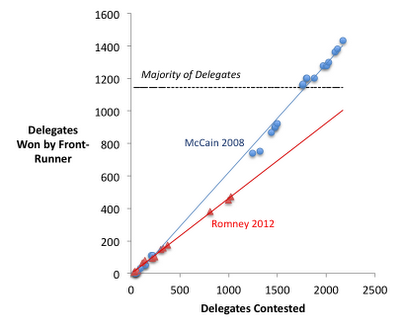
The thing I immediately noticed… the total number of delegates was different in 2008 and 2012! In 2008 there were 2380 delegates total. In 2012 there are only 2286! So using absolute numbers of delegates on the axes is not doing a direct comparison. You need to look at these as percentages of the total number of delegates available.

So I redid the chart on that basis, using the data I had collected in my 2008 Delegate Race Page (which used CNN’s delegate counts, grabbed and put into a spreadsheet on a daily basis) and which I am now collecting in my 2012 Delegate Race Page (which uses the Soft Count from Greenpapers including DCW’s Superdelegate numbers also grabbed daily for a spreadsheet).

Now, both my 2012 and 2008 numbers include so called “fantasy delegates” projecting the eventual results from caucus states, etc, which many folks argue is not the right way to track delegates, but since both years followed that practice, it seems like a valid comparison.

In any case, the result is this:
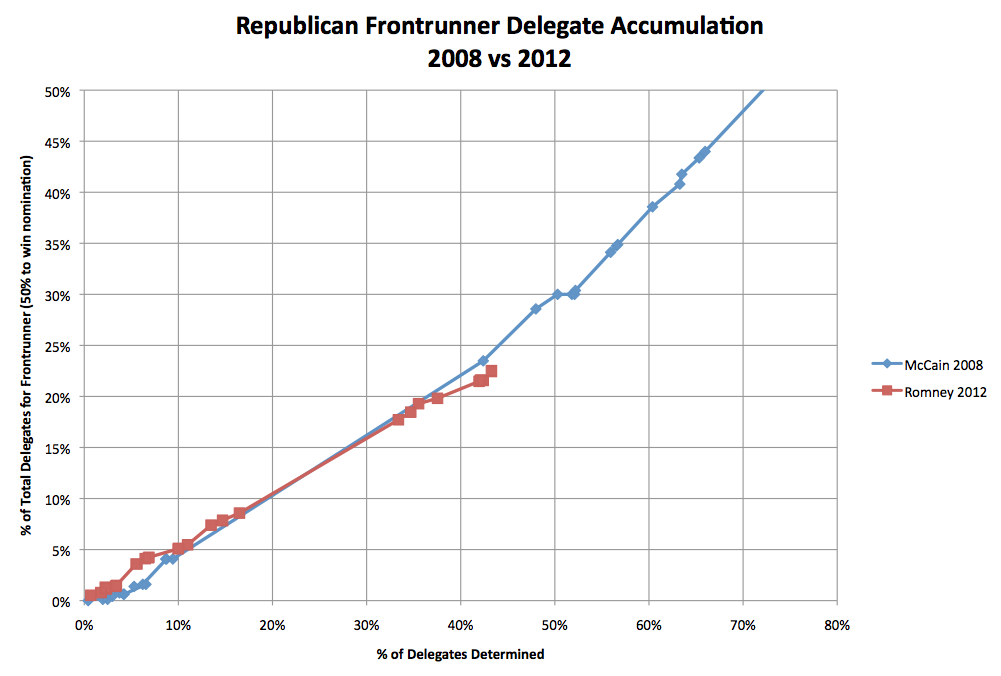
Romney is indeed behind McCain’s pace, but only very slightly, and that only developed in the last few contests. For most of the race so far, the pace of the two candidates tracked very closely, with Romney actually being ahead of McCain’s pace until Super Tuesday. He certainly is not as far behind as he appeared in Seth’s chart from Enik Rising. Rather, once you correct for both the calendar changes and the differing number of delegates, we see that the whole narrative of Romney being much slower to wrap things up than McCain was four years ago just falls apart.

I’ll note that using the Green Papers count instead of the RCP Count that Seth used puts Romney slightly BETTER than the pace he needs to get to 1144 rather than slightly worse than that pace. And indeed, which sources you use for both the 2008 and 2012 delegate counts probably matters here. Given how much the various estimates vary I imagine how far the two lines are from each other may be quite different based on which delegate counts you use… but the above is what I get using the sources I chose to use for tracking in these two cycles.

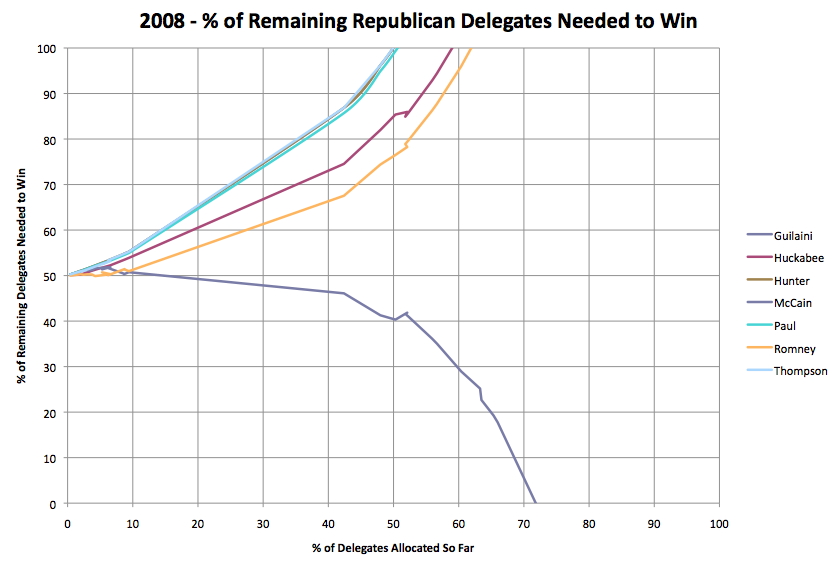
I’ll also use this opportunity to update the comparison between 2008 and 2012 using the metric I prefer… “% of remaining delegates needed to win”. This hits 100% once a candidate is mathematically eliminated or hits 0% once they have the needed number of delegates to secure the nomination.

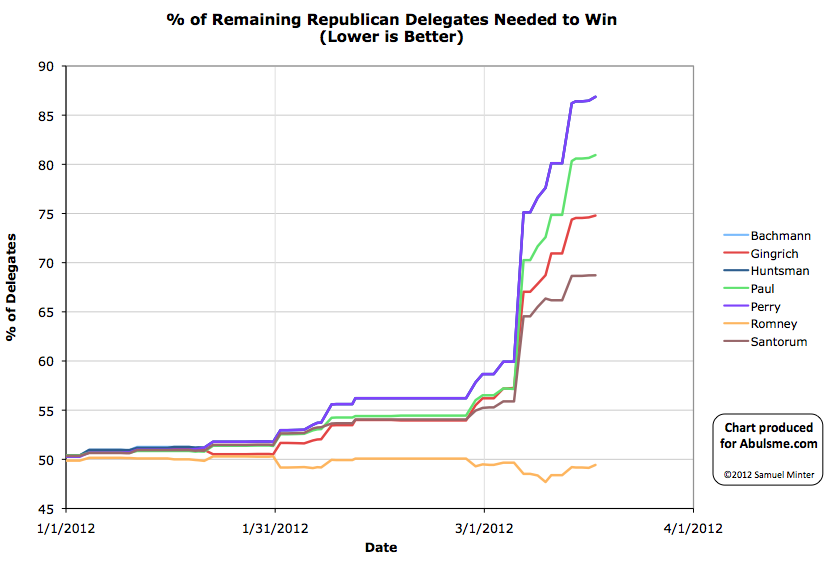
In 2008 on the Republican side the chart of this number for the various candidates looked like this:
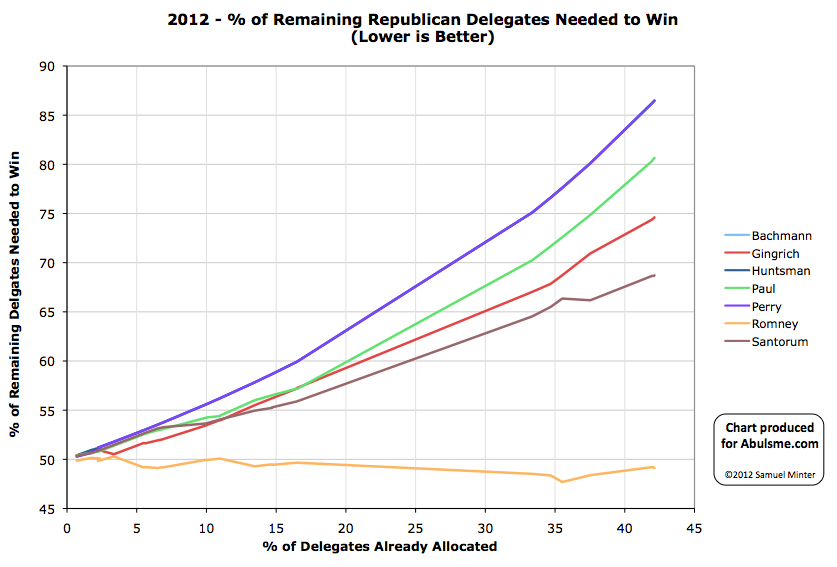
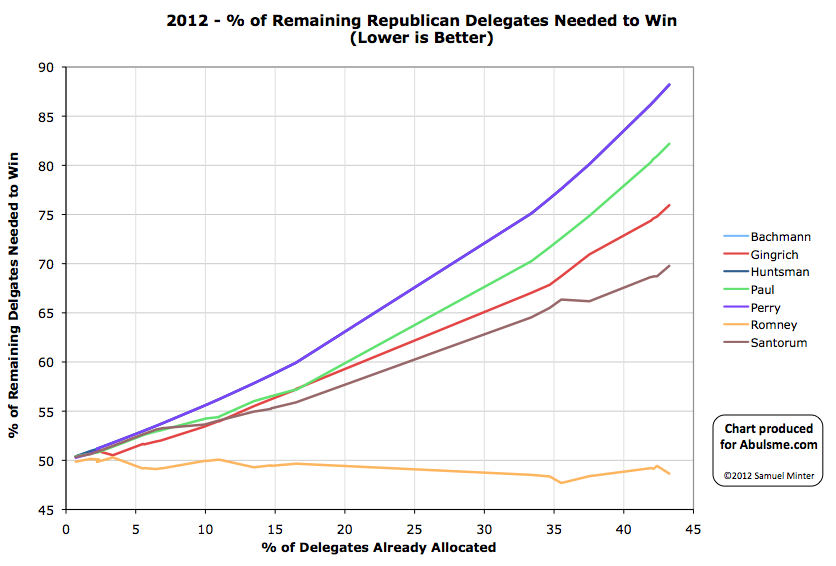
As of right now in 2012 (a few hours before the March 20th Illinois primary) this looks like this:
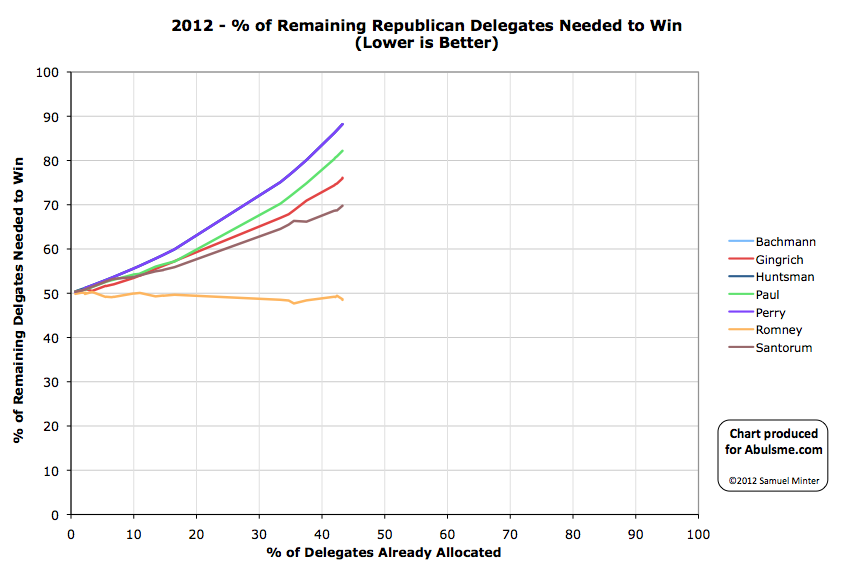
Comparing these, as with the other chart, you can see that McCain in 2008 was indeed a bit better off at this point than Romney is this time around, but not by a huge margin.

Using the sources I noted above, as of today 43.3% of the delegates have been allocated (or at least estimated in the case of those pesky fantasy delegates). As of today Romney needs 48.5% of the remaining delegates to wrap up the nomination.

The closest equivalent day in 2008 would have been February 6th 2008 (just after Super Tuesday, with incomplete delegate results from those contests as results trickled in over several days) with 42.4% of the delegates determined (or estimated). At that point McCain needed 46.1% of the remaining delegates to win. Unquestionably better than Romney today, just not by a HUGE margin yet.

In any case, the massive perception difference in terms of how well Romney is “wrapping it up” in 2012 compared to McCain in 2008 is almost all due to the spread out calendar. In reality, Romney is actually only a little bit behind McCain’s pace four years ago. It just SEEMS like he is much much further behind due to the fact it is the end of March at this point rather than the beginning of February which is when we were at the equivalent point in the delegate race back in 2008.

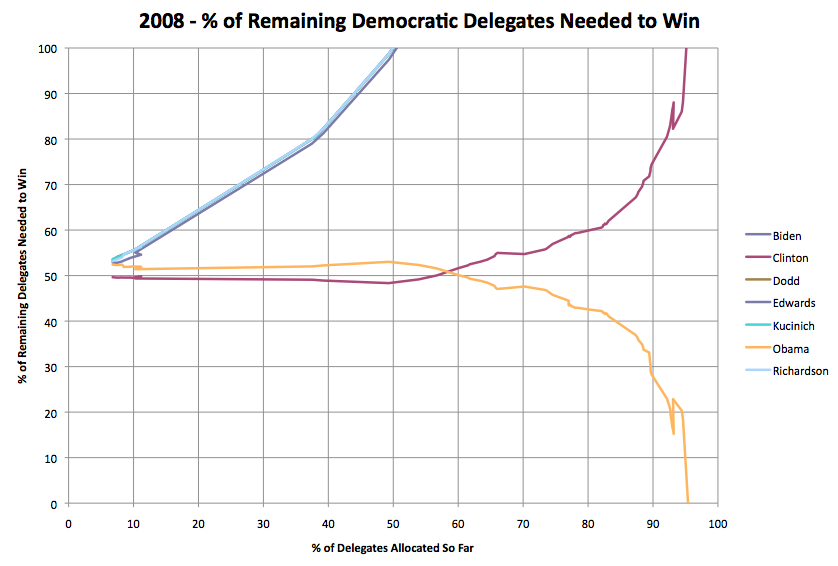
Finally, just for an additional comparison, here is the same graph for the Democrats in 2008…
(Minor wording edits and fixes were made in the 90 minutes or so after posting.)
2012 Republican Delegate Count: Georgia Update

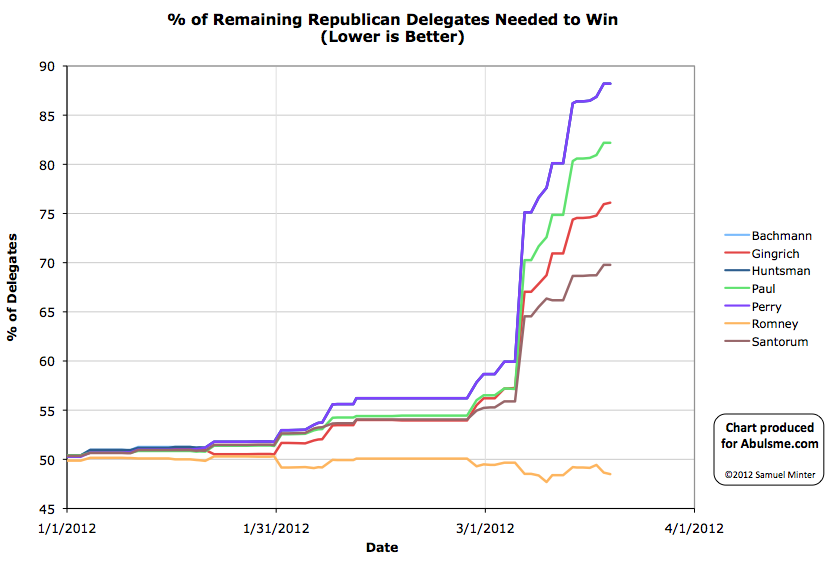
Chart from the Abulsme.com 2012 Republican Delegate Count Graphs page. When a candidate gets down to 0%, they have cinched the nomination. If they get up past 100%, they have been mathematically eliminated. Note that these numbers include estimates of the eventual results of multi-stage caucus processes which will be refined as the later stages occur.

A minor update from Georgia today. My primary source, Green Papers, previously had the results from Georgia as Gingrich 54, Romney 19, Santorum 3. This has now been updated to Gingrich 52, Romney 21, Santorum 3.

So the net for the day is Romney +2, Gingrich -2.

So Romney’s “% of remaining needed to win” drops from 48.7% to 48.5%. (And Gingrich’s rises from 75.9% to 76.1%.)

This is a minor change that does not change the state of the race significantly. But since there is an update today, it gives me a chance to modify something I said in the last update based on new information. I had said:

Next up is Illinois. Romney is ahead in the polls in Illinois, but isn’t over 48.7% in those polls, and of course nobody else is close to the numbers above either. The contest there is a “Loophole Primary” which is a bit odd, but if the delegate results are even close to being proportional to the popular vote result, then we can expect Illinois to be another of the “everybody loses” states where nobody actually gets closer to the nomination in terms of being on pace to win.

Well. two things.

First, recent polls have been moving in Romney’s direction over the last week. The most recent poll as of this writing was a poll from PPP (pdf) that has Romney at 45%. Now, polls predict popular vote, not delegates, and the 48.5% Romney needs is a percentage of delegates, not a percentage of the popular vote. But assuming at least some correlation between popular vote and delegates, those numbers are getting pretty close to each other. Which brings us to…

Second, Santorum failed to properly file for delegate slates in some parts of the state. This means that Santorum’s delegate take will almost certainly underperform his performance in the popular vote. This implies that Romney’s delegate take may well overperform his popular vote number.

With these two factors together, Romney’s chances of getting to the 48.5% he needs to improve his “% of remaining” number and move closer to the nomination and further away from the scenarios where he doesn’t get to 1144 is much more likely than it looked previously.

By this time tomorrow, we should know how that turned out.

@abulsme Updates from 2012-03-19 (UTC)

  • Reading – Backroom Deal Kept Romney On Illinois Ballot (Pema Levy March) http://t.co/tkMs6hkh #
  • RT @LarrySabato: With 83% for Romney, why did Santorum go to Puerto Rico? A sunny shirtless vacation. #
  • Reading – Iran Official Offers 'Human Monitoring' of Nuclear Sites (Christiane Amanpour) http://t.co/ucFNTwWq #

2012 Republican Delegate Count: Puerto Rico

Chart from the Abulsme.com 2012 Republican Delegate Count Graphs page. When a candidate gets down to 0%, they have cinched the nomination. If they get up past 100%, they have been mathematically eliminated. Rather than the date on the x-axis, we show the “% of Delegates Already Allocated” as this better represents the progress through the race. Note that these numbers include estimates of the eventual results of multi-stage caucus processes which will be refined as the later stages occur.

So. Puerto Rico. Romney wins by a huge margin. He got more than 80% of the vote. In second place Santorum got less than 10% of the vote. 50% was the magic number though. The rules for Puerto Rico said that if the winner gets more than 50%, then the delegates are allocated winner take all. So Romney gets all 20 regular delegates from Puerto Rico. (Romney already had 2 of the 3 super delegates from Puerto Rico before tonight, with Gingrich having the remaining super delegate.)

Obviously getting 100% of today’s delegates is good for Romney, and bad for everybody else. Duh. Romney’s best position so far was still on March 10th, right after Guam and the Northern Marianas results, but before Kansas and the Virgin Islands. But he moves back toward the nomination, and away from the possibility of not getting to 1144 with this result. The others continue on their rapid path toward mathematical elimination. In terms of the magical “% of remaining delegates needed to win” number:

  • Romney: 49.4% -> 48.7%
  • Santorum: 68.7% -> 69.8%
  • Gingrich: 74.8% -> 75.9%
  • Paul: 80.9% -> 82.2%

Next up is Illinois. Romney is ahead in the polls in Illinois, but isn’t over 48.7% in those polls, and of course nobody else is close to the numbers above either. The contest there is a “Loophole Primary” which is a bit odd, but if the delegate results are even close to being proportional to the popular vote result, then we can expect Illinois to be another of the “everybody loses” states where nobody actually gets closer to the nomination in terms of being on pace to win.

Add that to Louisiana, which will almost certainly also be an “everybody loses” state and we should wrap up the March contests with basically the same situation we have right now… the 3-non Romney’s with no chance of winning, but Romney still in the zone where being blocked from 1144 is very much still within the realm of possibility.

And then we’ll have April.

One thing to watch… does Romney remain in the zone where his “% of remaining needed to win” is less than the “% of delegates so far” number. If so, then continuing at the same pace will eventually get him to 1144, just really slowly. If not, then he’ll actually not be on a winning pace, and will have to actually improve his delegate collection rate to win. (Right now Romney has 51.9% of the delegates so far, compared to needing only 48.7% of the remaining delegates to win.)

Curmudgeon’s Corner: Oops a Daisey

In the latest Curmudgeon’s Corner…

Sam and Ivan talk about:

  • Election 2012
  • New iPad Launch
  • Iran / Syria
  • TAL Retraction

Just click to listen now:

[wpaudio url=”http://www.abulsme.com/CurmudgeonsCorner/cc20120318.mp3″ text=”Recorded 18 Mar 2012″]

or

1-Click Subscribe in iTunes

View Podcast in iTunes

View XML Feed

@abulsme Updates from 2012-03-18 (UTC)

2012 Republican Delegate Count: More Updates for Alabama and Hawaii

Chart from the Abulsme.com 2012 Republican Delegate Count Graphs page. When a candidate gets down to 0%, they have cinched the nomination. If they get up past 100%, they have been mathematically eliminated. Note that these numbers include estimates of the eventual results of multi-stage caucus processes which will be refined as the later stages occur.

Looks like we finally have final results for all the delegates from Alabama, and what will (maybe?) be a final update for Hawaii as well. All of this from Green Papers of course.

In Alabama we add 4 more delegates for Santorum and 2 more for Gingrich. This brings the total for non-Super delegates in Alabama to 22 Santorum, 14 Gingrich, 11 Romney. (Santorum also has one of the three superdelegates for the state, the other two haven’t endorsed yet.)

In Hawaii, the update we listed on March 15th is reversed. At that time a delegate was removed from the Paul column and given to Romney. Today that delegate appears to go back into the Paul column. This leaves Hawaii at 9 Romney, 5 Santorum, 3 Paul. So +1 Paul, -1 Romney.

So the net for today’s update: Santorum +4, Gingrich +2, Paul +1, Romney -1.

This gives changes for the “% of remaining needed to win” number as follows:

  • Romney: 49.13% -> 49.43%
  • Santorum: 68.71% -> 68.72%
  • Gingrich: 74.60% -> 74.79%
  • Paul: 80.65% -> 80.94%

Notice that everybody goes up. This is a small number of delegates of course, and pretty small changes to the numbers, but nobody here actually improved their position in terms of being able to get to 1144. Of the net 6 new delegates today, Santorum got 4. So 66.67%. Which is quite a healthy percentage. Overwhelmingly wins the day. But he would have had to have done even better to actually be on a pace to catch up with Romney. Lots of splits like this lead toward nobody getting 1144.

But this was a minor update day with a small number of delegates. We’ll see what the real contests get us over the coming week.

This American Life Retraction

Since I posted about the original story when it aired, it is only fair that I post the retraction in the same way. This American Life had done a story in January which I called at the time “particularly captivating and a little disturbing”. Well, it turns out it was mostly lies. Well, the details were lies. The narrative from Mike Daisey was mostly fabricated. Many of the underlying concerns about working conditions, etc had roots in the truth, but a lot of the details and specific incidents were just plain made up. The retraction is almost as powerful as the original episode. It is also well worth listening to.

This American Life #460:
Retraction
Originally Aired 03.16.2012

Regrettably, we have discovered that one of our most popular episodes was partially fabricated. This week, we devote the entire hour to detailing the errors in “Mr. Daisey Goes to the Apple Factory,” Mike Daisey’s story about visiting Foxconn, an Apple supplier factory in China. Rob Schmitz, a reporter for Marketplace, raises doubts on much of Daisey’s story.

Looks like they aren’t allowing embedding for this episode, at least not yet, so you’ll need to click through above to listen.

I find this kind of thing absolutely infuriating. When someone has something very real and a story that deserves to be told, an issue that needs to get out there. Something important that people should know about. But then they decide to make it really compelling they need to do more. So they embellish or make things up to fill out the picture. Or they take ethical shortcuts like the Peter Gleick Heartland Scandal earlier this year. Or for that matter the Dan Rather George Bush Memos. This kind of stuff is all frustrating. Their might be an underlying truth worth knowing, but when people lie and fabricate and misrepresent, it completely overwhelms any of that underlying truth and puts everything in doubt.

@abulsme Updates from 2012-03-17 (UTC)

  • Reading – Retracting "Mr. Daisey and the Apple Factory" (This American Life) http://t.co/MLSNQsGo #
  • RT @mattyglesias: Amazing how primitive Captain Kirk's communicator is compared to my iPhone. #
  • RT @mattyglesias: On the other hand, Siri is awful compared to Starfleet's voice operated computers. #
  • RT @ModeledBehavior: This whole Mike Daisey debacle doesn't make me trust Ira Glass any less. Class act, clearly cares about the truth. #
  • Reading – Obama quaffs Guinness pint in St Patrick’s Day outing (Olivier Knox) http://t.co/jOblB3E5 #
  • Reading – All Odds Aside, GOP Girding for Floor Fight (Meggan Haller) http://t.co/Pr80J3Ot #
  • Reading – WTF: Beginning in July, ISP’s will start monitoring and policing user activity (BitShare) http://t.co/v5bnEAJ1 #
  • Reading – Do The Primaries Still Matter? (Andrew Sullivan) http://t.co/sIRaGwzg #
  • Reading – Lies (Jeff Jarvis) http://t.co/QZbzIdT1 #
  • Reading – A Few Thoughts on the Missouri Caucuses (Josh Putnam) http://t.co/d7st6a4j #
  • Reading – In Need of a Game Change, Santorum Plays Small Ball (Nate Silver)
    http://t.co/PaS3alVC #

2012 Republican Delegate Count: Another Super for Romney

Chart from the Abulsme.com 2012 Republican Delegate Count Graphs page. When a candidate gets down to 0%, they have cinched the nomination. If they get up past 100%, they have been mathematically eliminated. Rather than the date on the x-axis, we show the “% of Delegates Already Allocated” as this better represents the progress through the race. Note that these numbers include estimates of the eventual results of multi-stage caucus processes which will be refined as the later stages occur.

Very minor update today. One new superdelegate from Indiana endorsed Romney. You can barely see the effect on the charts with a microscope. If one must look, Romney’s “% of remaining needed to win” drops from 49.17% to 49.13%. Santorum’s rises from 68.66% to 68.71%. At this stage, one delegate barely budges the numbers.

So we await Puerto Rico this weekend for the next big batch of delegates.