| In the latest Curmudgeon’s Corner…
Sam and Ivan talk about:
Just click to listen now: [wpaudio url=”http://www.abulsme.com/CurmudgeonsCorner/cc20120311.mp3″ text=”Recorded 11 Mar 2012″] or
|
 |
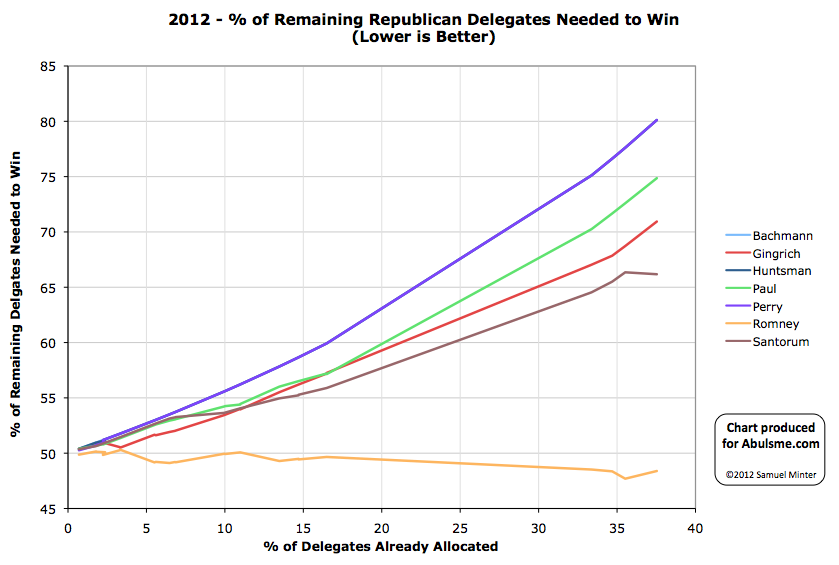
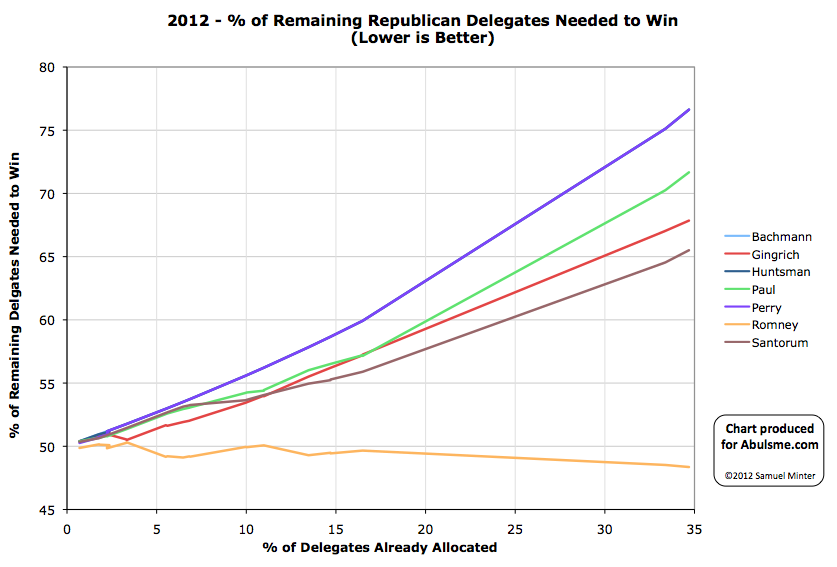
Chart from the Abulsme.com 2012 Republican Delegate Count Graphs page. When a candidate gets down to 0%, they have cinched the nomination. If they get up past 100%, they have been mathematically eliminated. Rather than the date on the x-axis, we show the “% of Delegates Already Allocated” as this better represents the progress through the race. Note that these numbers include estimates of the eventual results of multi-stage caucus processes which will be refined as the later stages occur. For the first time since Gingrich won South Carolina, someone other than Romney ends up improving their overall position after a day with results from major contests. Yes, Santorum actually pulled one out! In Kansas Santorum won 33 delegates to Romney’s 7. In the Virgin Islands, Romney won 4 delegates, Paul won 1. Romney also picked up one additional superdelegate from the Virgin Islands. This makes the totals for the day: Santorum 33, Romney 12, Paul 1. In order to be on a pace to catch up and get to 1144, Santorum needed 66.4% of the delegates. With 33/46 he manages 71.7% of today’s delegates. This means his “% of remaining needed to win” drops to 66.2% for the next set of contests on Tuesday. So not only does Santorum win the day, he wins the day by a big enough margin to be on pace to win! Well, we would be if he did this every single time there was a contest, which won’t happen, but hey, today, he did it today! (Note: If you counted the two Pacific Island contests that I gave the results of yesterday as if they were all on the same day as Kansas and the Virgin Islands, Santorum would no longer be up for the day.) Meanwhile, all of the other candidates of course moved backwards, including Romney. Romney moves from needing 47.7% of the remaining delegates to needing 48.4% of the remaining delegates. He will be hard pressed to make this margin in Tuesday’s deep South contests, so expect that he may move backwards some more before moving toward the nomination again, but he is still in the commanding position in this race. Nobody else is even close. He is the only one with a path to 1144. (Prospects for the non-Romney’s to block remain possible however, although the non-Romney’s have to pick up the collective delegate getting pace to make that happen, rather than fading as their chances of winning individually rapidly go to zero.)
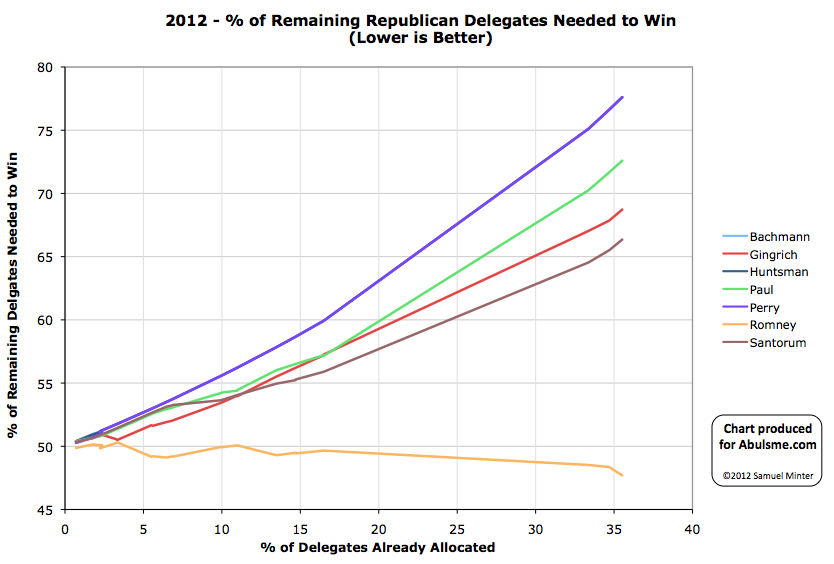
Chart from the Abulsme.com 2012 Republican Delegate Count Graphs page. When a candidate gets down to 0%, they have cinched the nomination. If they get up past 100%, they have been mathematically eliminated. Rather than the date on the x-axis, we show the “% of Delegates Already Allocated” as this better represents the progress through the race. Note that these numbers include estimates of the eventual results of multi-stage caucus processes which will be refined as the later stages occur. This is the kind of day the not-Romneys wish wouldn’t happen. It is the kind of day that starts taking even the possibility of keeping Romney from getting to 1144 off the table. It highlights Romney’s superior organization and money by letting him get delegates somewhere the others probably hadn’t even thought of competing. Neither Guam nor the Northern Mariana Islands were technically winner take all. There had been no polling at all. But when all was said and done, support for Romney here was overwhelming (actually unanimous in the small Guam Caucus) and it ended up effectively winner take all. Officially the delegates from these contests are supposed to be uncommitted, but in both locations, the result was made clear. Out of these two locations Romney gets 12 regular delegates. Also 6 super delegates from these locations also are now in the Romney column. Plus, one super delegate from the Virgin Islands also came out for Romney. That makes Romney’s take for the day a 19 delegate gain, while all other candidates were shut out completely. So Romney’s “% of remaining needed to win” drops from 48.4% to 47.7%. Meanwhile Santorum as the closest competition goes from needing 65.5% to needing 66.4%. Santorum and the others continue to race toward mathematical elimination with each contest. Romney isn’t “racing” toward cinching the nomination yet, but he is making steady progress in that direction now. Some of the Southern states coming up may slow or reverse that process in the short term, but it getting increasingly hard to game out scenarios where Romney does not eventually get to 1144. It is just a question of how long it takes.
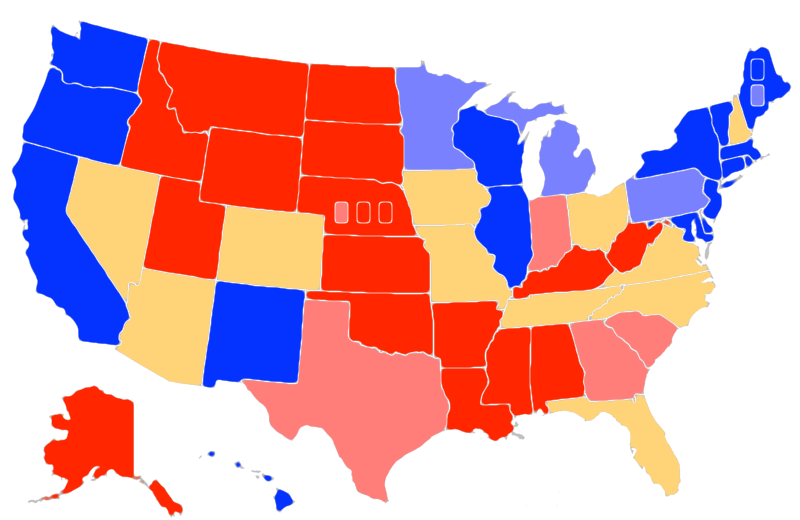
Map from the Abulsme.com 2012 Electoral College Prediction page. This map reflects Obama vs Romney. If any other candidate takes the lead in the Republican delegate race we’ll switch to making maps for them. So the latest poll in Maine (the first since October) puts our “last five poll average” up an Obama lead of 12.1%, so the state moves from our light blue color (indicating a 5% to 10% lead) to dark blue (indicating a lead over 10%). Obama won Maine in 2008 by over 17%, so this isn’t a huge surprise. This is for the whole state though. Maine is one of two states (the other is Nebraska) that allocate some of their electoral votes based on the state wide vote, but some of them by the winners in each congressional district. We have no polling yet for the individual congressional districts in Maine, so they are colored in by the average of the results in 2004 and 2008. So we classify ME-1 as Strong Obama (lead over 10%) and ME-2 as Weak Obama (lead between 5% and 10%). In practice these states have almost never split their vote, but it does happen sometimes… Nebraska split its vote in 2008… so we have to allow for the possibility in our model. Since this change does not effect a swing state, our summary remains the same:
And our chart over time…
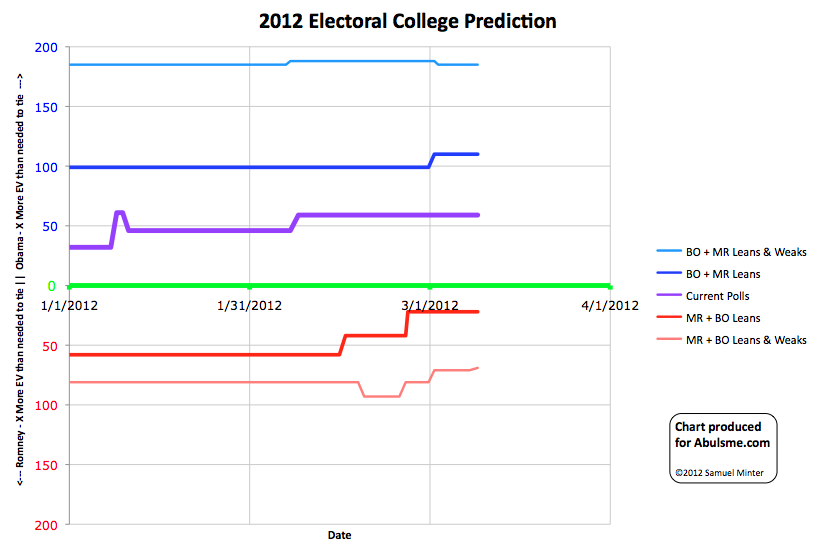
Chart from the Abulsme.com 2012 Electoral College Prediction page. In the last month there have been 8 state category changes. 6 of them have gone in Obama’s direction. It will be awhile until the state by state polls are frequent enough and in enough states to be quickly responsive to the state of the race, but from the polling we do have, it is apparent that the continuing Republican primary battle seems to be slowly but surely weakening Romney’s hand against Obama. The expectation is that once Romney can pivot to the general election, he’ll be able to start trying to reverse that tide. But until then, he seems to just continue to lose ground.
Chart from the Abulsme.com 2012 Republican Delegate Count Graphs page. When a candidate gets down to 0%, they have cinched the nomination. If they get up past 100%, they have been mathematically eliminated. Rather than the date on the x-axis, we show the “% of Delegates Already Allocated” as this better represents the progress through the race. Note that these numbers include estimates of the eventual results of multi-stage caucus processes which will be refined as the later stages occur. So it appears that the last 34 delegates from Super Tuesday, a handful each from Georgia, Ohio and Tennessee, have been determined. 17 more to Romney, 8 more to Gingrich and 5 more to Santorum. But wait, that is only 30! Well, according to Green Papers, 4 of the 63 delegates that were up for grabs in Ohio end up officially “Uncommitted”, which (I think) means we won’t actually know which way they may go until we know which actual human beings end up being those delegates and those people say publicly who they plan on supporting (which they may or may not actually do before the convention). All in all, today’s results are once again a win for Romney. He got 56.7% of today’s delegates, which was way more than the 48.5% he needed to continue to move closer to the nomination rather than further way. His “% of remaining needed to win” drops now to 48.4%. For the other candidates, the effect on the other side is more dramatic. Santorum is still in 2nd place, but his “% of remaining needed to win” moves up from 64.5% to 65.5%. Romney may not yet be rapidly moving toward cinching the nomination, but the non-Romneys are rapidly moving toward being mathematically eliminated. Looking at the non-Romney’s for a minute, the next few states are expected to favor them. Perhaps Santorum will win some. Perhaps Gingrich will win some. But to actually be on a pace to win, Santorum has to not just win a state, but win by a huge margin, getting more than 65.5% of the delegates. For Gingrich it is even worse, he would need to win getting 67.8% of the delegates. (For completeness, Paul would need to get more than 71.7%.) Even with Romney expected to not be strong in these states, with four candidates in the race, you don’t expect anybody to be able to pull that kind of level except in winner take all (or winner take almost-all) states. Of the next few coming up… in Kansas, Guam, Northern Marianas, Virgin Islands, Alabama, Mississippi, Hawaii and American Samoa there are as usual complicated delegate rules (and the territories might only select uncommitted delegates), but none of them are straight up winner takes all. (Some allow for certain situations that could lead there though.) Bottom line, 65.5% (or more) is a pretty big ask and seems unlikely. Which means that even if Santorum or Gingrich win some states (as expected) in terms of delegates they will almost certainly still both be heading closer to mathematical elimination rather than closer to the nomination. The big thing to look at will once again be looking at how well the non-Romney’s collectively block Romney from getting the 48.4% of the delegates he needs to be closing in on the nomination himself. With strong performance by the non-Romney’s in the next few contests, they may well be able to achieve this, even if they don’t actually help themselves individually.
|
||||||||||||||