This is the website of Abulsme Noibatno Itramne (also known as Sam Minter). Posts here are rare these days. For current stuff, follow me on Mastodon

Categories

Calendar

March 2026
S M T W T F S
1234567
891011121314
15161718192021
22232425262728
293031  

Republicans: After March 8th, still in contested convention zone, but Trump in good position to change that

On the Republican side March 9th brought results from Hawaii, Idaho, Michigan and Mississippi. The results were:

Trump +73, Cruz +59, Kasich +17, Rubio +1

The projections I made a few days ago based on polling were:

Projected total for March 8th: Trump +91, Cruz +28, Rubio +18, Kasich +12, Carson +1

Despite his wins, Trump considerably underperformed what his polling indicated just a couple days beforehand, while Cruz beat his estimates by quite a bit. Rubio, well, Rubio just flamed out.

Now, this is still a Trump win, but the fact that it was less than the polls would have predicted may mean that there is weakness in Trump that is not being captured by the latest polls.

Also, it was not enough to put him on track to get back out of the “contested zone” where we are on track for a contested convention, and back to a place where he actually has a majority of the delegates.

Lets look at the “% of remaining delegates needed to win” graph:
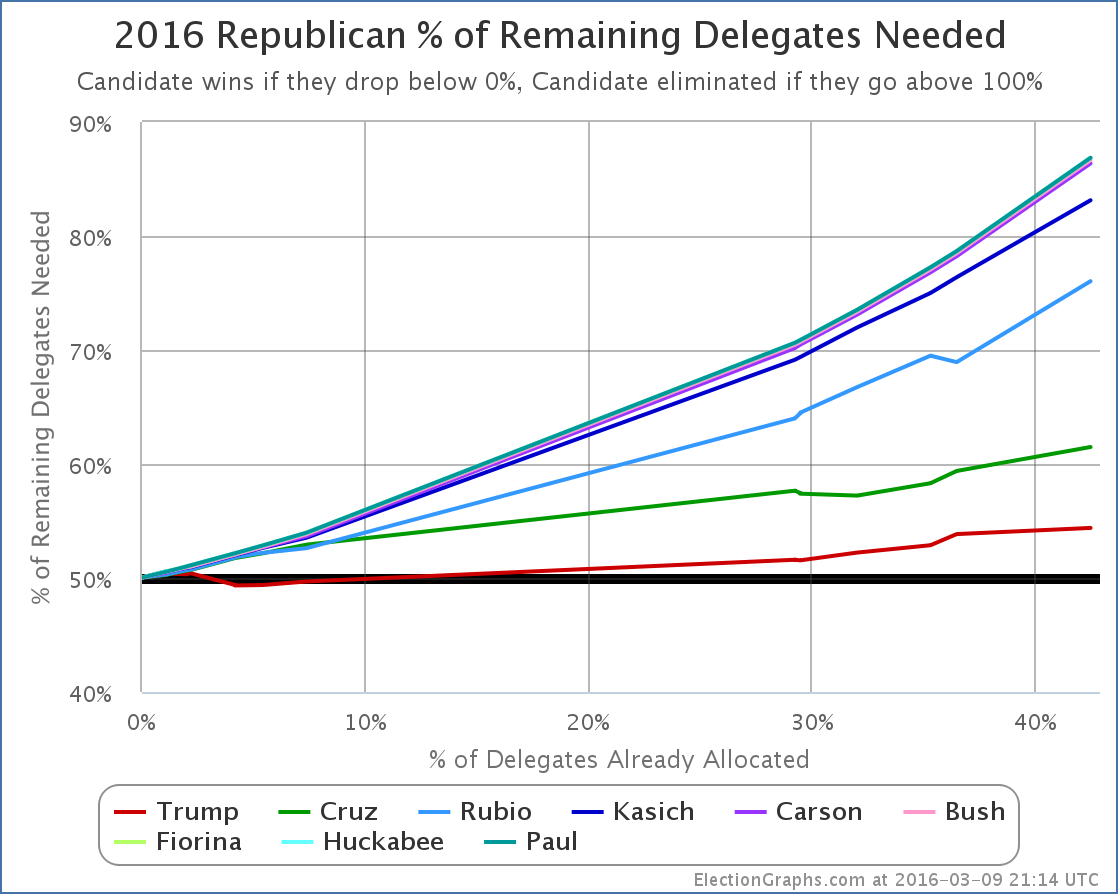
chart (100)

Before today, Trump needed 53.85% of the delegates to be on track for an outright win. For the night he got 48.67% of the delegates. Not quite there. So his % needed for the next contests increases to 54.39%.

This is getting high given that his history to date is only getting 44.14% of the delegates. He needs to improve his rate of delegate acquisition by about 23% to head toward an outright win.

If the remaining states were all straight proportional, it might already be time to start saying the likelyhood of the contested convention was getting to the point that anything else would be a surprise.

But the Republican contests are almost all biased at least a little bit to the winner, and starting March 15th, we have a number of high delegate winner take all states, most notably Florida and Ohio.

As I’ve been doing, lets look at the next few contests. This time lets go all the way through the big March 15th day. As usual, using RCP poll averages and delegate distribution rules from Green Papers.

Florida – 99 delegates – March 15th:

  • Poll averages: Trump 40.2%, Rubio 24.4%, Cruz 17.4%, Kasich 8.4%
  • Delegate estimate: Trump 99

North Carolina – 72 delegates – March 15th:

  • Poll averages: Trump 32.7%, Cruz 21.7%, Rubio 15.3%, Kasich 9.7%
  • Delegate estimate: Trump 30, Cruz 20, Rubio 14, Kasich 8

Illinois – 69 delegates – March 15th:

  • Poll averages: Trump 32.7%, Rubio 18.7%, Cruz 17.7%, Kasich 13.3%
  • Delegate estimate: Trump 37, Rubio 12, Cruz 11, Kasich 9

Ohio – 66 delegates – March 15th:

  • Poll averages: Trump 39.0%, Kasich 34.0%, Cruz 15.3%, Rubio 7.0%
  • Delegate estimate: Trump 66

Missouri – 52 delegates – March 15th:

  • No recent polls, using national avg: Trump 36.0%, Cruz 21.8%, Rubio 18.0%, Kasich 12.0%
  • Delegate estimate: Trump 52

Wyoming – 29 delegates – March 12th:

  • No recent polls, using national avg: Trump 36.0%, Cruz 21.8%, Rubio 18.0%, Kasich 12.0%
  • Delegate estimate: Trump 12, Cruz 7, Rubio 6, Kasich 4

District of Columbia – 19 delegates – March 12th:

  • No recent polls, using national avg: Trump 36.0%, Cruz 21.8%, Rubio 18.0%, Kasich 12.0%
  • Delegate estimate: Trump 9, Cruz 5, Rubio 5

Virgin Islands – 9 delegates – March 10th:

  • No recent polls, using national avg: Trump 36.0%, Cruz 21.8%, Rubio 18.0%, Kasich 12.0%
  • Delegate estimate: Trump 4, Cruz 2, Rubio 2, Kasich 1

Guam – 9 delegates – March 12th:

  • No recent polls, using national avg: Trump 36.0%, Cruz 21.8%, Rubio 18.0%, Kasich 12.0%
  • Delegate estimate: Trump 4, Cruz 2, Rubio 2, Kasich 1

Northern Marianas – 9 delegates – March 15th:

  • No recent polls, using national avg: Trump 36.0%, Cruz 21.8%, Rubio 18.0%, Kasich 12.0%
  • Delegate estimate: Trump 9

Now, lots of assumptions there. Also, Wyoming and some of the territories are actually directly electing delegates and we may not know their preferences on election night, so they may be listed as unbound or TBD for awhile. But lets do the addition anyway. From the above we end up with:

March 10th to March 15th estimate: Trump 322, Cruz 47, Rubio 41, Kasich 23

That would give Trump a whopping 74.36% of the delegates, well above the 54.39% he needs.

Now, because that includes some big winner take all, and some more that are winner-take-most, that is highly volatile. If he loses Florida… or Ohio, where the race is a lot closer… then things start to look worse for Trump very quickly. In terms of winning outright… not necessarily in terms of keeping the delegate lead.

But given the results above, does Trump get back to a delegate majority?

The new totals would be:

Trump 785, Cruz 409, Rubio 196, Kasich 77, Others 15

Trump would have 52.97% of the delegates. He would be back on track for an outright win.

Not only that, but 1482 of the 2472 delegates would already have been allocated. That is just a hair under 60%. Only 990 delegates would be left. And Trump would already have 785 of the 1237 delegates he would need to win outright. So he would only need 452 more delegates… or 45.66% of the remaining delegates. Which would probably be an easy ask given where the campaign would be at that point and the number of winner take all and/or winner take most states coming up. If he wins both states, the chances of a contested convention drop dramatically. We’re almost certainly looking at a clean Trump win.

Take away Ohio and Trump would no longer have a majority at this stage, and would still need 52.32% of the remaining delegates to win outright. This would still be very doable, just a little bit harder. In this scenario, we might be hanging on the edge between the contested convention and the Trump win for awhile.

Take away Ohio AND Florida and not only would Trump not have a majority, but he would need a full 62.32% of the remaining vote to win outright. This number would be more difficult to achieve, and the chances of a contested convention would then be very very high.

Now, this of course assumes the results are somewhat similar to the projections above in the other states too… but the general outlines of this are likely to remain true.

Where we are after March 15th will depend in huge part on Florida and Ohio. Right now Trump is way ahead in Florida, and has a slim lead in Ohio. But Trump has been underperforming his polls lately. If that trend continues, things may be closer than they look right now.

There are five and a fraction days left, including one more debate. So there is room for considerable movement as well.

But Trump has a significant advantage at this point. We are currently in the “contested convention” zone… but Trump is in a very good position to knock us out of there and into the “Trump wins” zone.

Note: This post is an update based on the data on ElectionGraphs.com. Election Graphs tracks both a poll based estimate of the Electoral College and a numbers based look at the Delegate Races. All of the charts and graphs seen in this post are from that site. Additional graphs, charts and raw data can be found there. All charts above are clickable to go to the current version of the detail page the chart is from, which may contain more up to date information than the snapshots on this page, which were current as of the time of this post. Follow @ElectionGraphs on Twitter or like Election Graphs on Facebook to see announcements of updates or to join the conversation. For those interested in individual general election poll updates, follow @ElecCollPolls on Twitter for all the polls as they are added.
@ElectionGraphs tweets from 2016-03-09 (UTC)

@ElecCollPolls tweets from 2016-03-09 (UTC)

@abulsme tweets from 2016-03-09 (UTC)

Democrats: Clinton wins day despite surprise Sanders Michigan win

You may have heard all the breathless coverage last night of Sanders’ surprise win in Michigan. And it was indeed a surprise. He outperformed all the recent polls by a substantial margin. This was a big huge win, right?

Well, no. It wasn’t. The media hype is all around the fact that it is more interesting to cover an actual race than a slow march to an almost inevitable win. Time to look at the numbers.

First of all, the straight up delegates out of Michigan: Sanders 69, Clinton 61

That means Sanders got 53.1% of the Michigan delegates. To be on a pace to catch up and win, he needed 60.2% of the delegates. He may have “won”, but he didn’t win by anywhere near enough to actually catch up with Clinton.

But Michigan wasn’t the only state handing out delegates. Mississippi did too. And Mississippi went for Clinton 32 to 4. So the total for the day was actually Clinton 93 to Sanders 73.

There were also some superdelegate updates since my last post. Net change: Clinton +4, Sanders +3.

So total since the Maine results on Sunday: Clinton 97, Sanders 76.

So Sanders only got 43.9% of the delegates since Sunday. This is not close to 60.2%.

Yes, Sanders pulled out a surprise win in Michigan. But he could duplicate that win in EVERY STATE from here until the end of the primary season and he STILL would not catch up. He would not win. He can’t catch up by “just winning”. He needs to win by huge margins to catch up. That did happen (barely) in Maine. But Michigan didn’t do it, and Sanders has only very rarely managed the margins he would need to catch up.

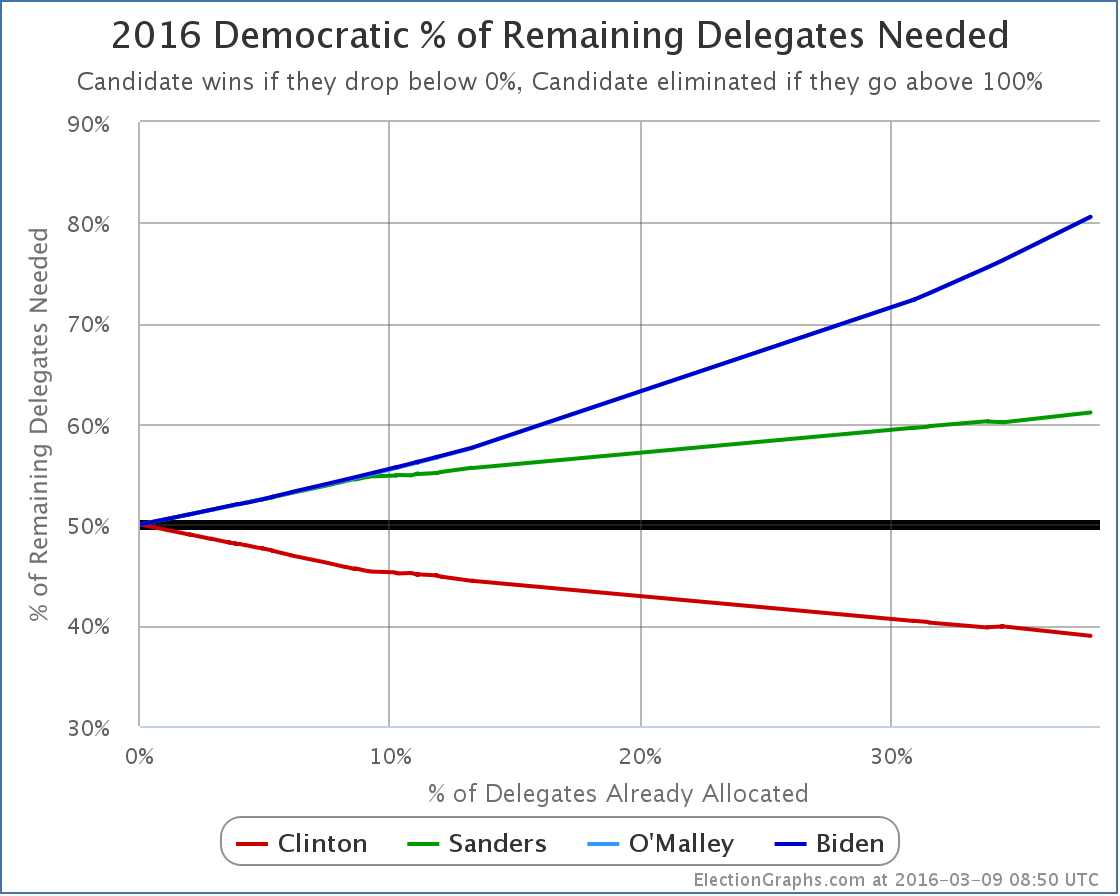
So, looking at the graph of “% of remaining needed to win”:

chart-68

Clinton now needs 38.96% of the remaining delegates to win. Sanders needs 61.14% of the remaining delegates to catch up.

Oh, unless the superdelegates start changing their minds in massive numbers. That would make things harder for Clinton and easier for Sanders. And to be fair, if all 460 of Clinton’s superdelegates flipped to Sanders tomorrow, Sanders would indeed be ahead by 1035 delegates to 771.

I wouldn’t hold my breath on that one though.

Right now the totals are Clinton 1231, Sanders 575.

Next up are the Northern Marianas on Saturday, then Florida, Illinois, Missouri, North Carolina and Ohio next Tuesday.

[Edit 16:22 UTC to add the following exchange]

Minutes after I posted this update, I got a comment via Facebook that prompted me to do some additional analysis. It seemed directly relevant and interesting, so adding it here (lightly edited):

Jenn: Since superdelegates have never actually gone against the popular vote and could change their minds, what’s the math if we simply exclude them? I’m not saying it’ll happen. I’m just curious and too lazy to do it myself.

Sam: On superdelegates, my position is that if they ever start to change their minds because of the results of the pledged delegate race, we will see that because they will say so. So speculating about them changing their minds is pointless, you can actually watch and see if they do. If they start changing their minds, then it is a real thing and it will be measured and tracked as it happens. So long as they don’t, it is just a fantasy. But OK, I’ll quickly do the calculation of what things would look like if you only look at pledged delegates and assume superdelegates will follow the pledged delegate result.

[Edit 2016-03-10 16:07 UTC to strike through the calculation below due to really bad stupid math error that completely invalidates the result. Sanders needed percentage will be closer to 55%. Redoing calculations shortly.]

Sam: OK. Here goes. The current totals are Clinton 1231, Sanders 575, O’Malley 1. If you take out supers, that becomes Clinton 771, Sanders 552. Now, there are 2472 delegates total, so you need 1237 delegates to win. But that includes superdelegates. If the assumption is that supers will go for the pledged delegate winner, then you shouldn’t count them in the total number of delegates either because they now don’t matter. Without supers there are 1755 delegates, and you need 878 to win. Sanders therefore needs 326 more delegates to catch up and win. Between Clinton and Sanders they have collected 1323 delegates already. So there are only 432 pledged delegates remaining. 326/432 = 75.5%. So if you look only at pledged delegates it is actually WORSE for Sanders. He needs nearly 76% of the remaining delegates to catch up and win rather than “only” 61%.

[Edit 2016-03-10 17:30 to add additional conversation correcting the erroneous calculation. I am leaving the first version struck out above for the record. The below is lightly edited from the original Facebook conversation.]

Sam: Urg!!!! I made a huge error on those calculations! I blame it on…. Uh…. Being stupid. I used the total number of Republican delegates in one part of the calculation rather than the Democratic totals, which of course invalidates the whole thing. I suspect Sanders actually needs closer to 55% if you don’t count supers. I will redo the calculation.

Sam: OK, here goes again. I suck. Numbers that have changed bolded. The current totals are Clinton 1231, Sanders 575, O’Malley 1. If you take out supers, that becomes Clinton 771, Sanders 552. Now, there are 4765 delegates total, so you need 2383 delegates to win. But that includes superdelegates. If the assumption is that supers will go for the pledged delegate winner, then you shouldn’t count them in the total number of delegates either. Without supers there are 4048 delegates, and you need 2025 to win. Sanders therefore needs 1450 more delegates to catch up and win. Between Clinton and Sanders they have collected 1323 delegates already. So there are only 2725 pledged delegates remaining. 1450/2725 = 53.2%. This is significantly better than the 41.7% of pledged delegates Sanders has gotten so far, but it is not yet in the impossible zone by a long shot, and it is still better than where he is when you include superdelegates. Apologies for the stupid error.

Sam: I had actually checked and rechecked the calculation several times before posting it originally, but I made the same mistake every time. Sigh! Oh well!

Sam: See also this article by Andrew Prokop for more on what would be involved in a Sanders comeback. It was while reading this that I realized my error.

[Update 2016-03-10 06:45 UTC – Update in Michigan shifts 2 additional delegates from Sanders to Clinton. This does not substantially change the analysis above. In addition, the number of total “unpledged PLEOs” was adjusted in several states, giving a net addition of 1 total convention delegate.]

[Update 2016-03-11 05:29 UTC – Superdelegate update: Clinton loses one as a second superdelegate says they will just vote for the pledged delegate winner, putting them back in the uncommitted category for now.]

[Update 2016-03-12 23:50 UTC – Superdelegate update to prepare for March 12th results: Clinton +1, Sanders +1]

Note: This post is an update based on the data on ElectionGraphs.com. Election Graphs tracks both a poll based estimate of the Electoral College and a numbers based look at the Delegate Races. All of the charts and graphs seen in this post are from that site. Additional graphs, charts and raw data can be found there. All charts above are clickable to go to the current version of the detail page the chart is from, which may contain more up to date information than the snapshots on this page, which were current as of the time of this post. Follow @ElectionGraphs on Twitter or like Election Graphs on Facebook to see announcements of updates or to join the conversation. For those interested in individual general election poll updates, follow @ElecCollPolls on Twitter for all the polls as they are added.

[Edit 15:59 to fix one place I said Sanders instead of Clinton. Fixed. Thanks Jenn for pointing it out.]

[Edit 2016-03-10 21:12 UTC to fix author of Vox article I linked to.]

Watch my son Alex’s YouTube channel!

Alex’s channel is here: ALeXMXeLA

We’ve now posted 10 episodes on Alex’s YouTube channel. There are 15 more that he has already recorded that I’ll be posting as soon as I can get to them. All the ones posted so far are Minecraft videos, but he’s been branching out into other games on some of the ones in the queue to be posted.

Please subscribe, please watch, please tell your friends to watch. Especially ones with K-3 age kids who might enjoy watching a six year old playing games. He is really excited about doing these, so it would be nice to have a few people looking.

I’ll especially call out Episode 8 here, because in it he requests that the people watching vote for who won the “Building Time” contest we had, and give suggestions for our next Building Time. So watch and leave your comments on YouTube!

Here is Episode 8, which he titled “Building Time – Nala Part 4”:

Thanks all!

[Edit 15:24 UTC to fix typo.]

@ElecCollPolls tweets from 2016-03-08 (UTC)

@abulsme tweets from 2016-03-08 (UTC)

@ElectionGraphs tweets from 2016-03-07 (UTC)

@abulsme tweets from 2016-03-07 (UTC)