As of right now… 2010 Oct 20 20:40 UTC (1:40 PM Pacific, 4:30 PM Eastern)… Amy is exactly 15 years old. Happy Birthday Amy!
Next up… driving!
|
As of right now… 2010 Oct 20 20:40 UTC (1:40 PM Pacific, 4:30 PM Eastern)… Amy is exactly 15 years old. Happy Birthday Amy! Next up… driving!
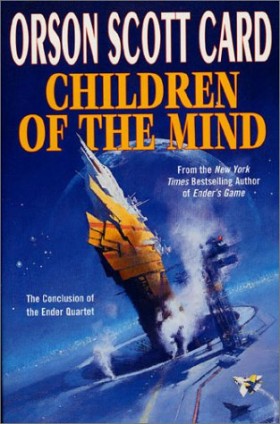
OK, now that is more like it. Almost 50 pages per day and a book finished in a week. Compared to the text book before this, that is just lightning speed… Of course, I’m usually much faster with fiction and this was an easy read. This is of course the next book (#4) in the Ender Series. I’m working my way through the series to get to #11, which Brandy gave me for Christmas or a birthday or something a couple of years back. :-) I had finished the last one back in April. This one continues directly from the previous book with no gap in time whatsoever. It follows a couple of “characters” who are essentially just artificial extensions of Ender himself as they (and others, including the original Ender) try to prevent the destruction of a planet and a sentient computer network. Continuing the trend of the last couple of books in this series, what goes on is decreasingly about events and actions or even characters, but instead is Card exploring a particular concept of the nature of the soul and what it means in relation to the various characters in the story, the species they belong to and toward the whole of the universe I guess. This is all an interesting thought experiment. He proposes a physical extra dimensional sort of thing that embodies the soul or the will or whatnot, and which essentially possesses physical objects, with the “stronger” of these things being able to take control of complex entities such as human beings and with the ability to “intertwine” with other of these things as embodiment of relationships between people, etc. He then pursues some of the ramifications of that sort of structure. As I said, interesting thought experiment. Overall a good book, if you are into the kind of book that is really more about exploring ideas and concepts that being a page turner based on plot alone. Oh, and of course, the most interesting character here continues to be Jane, the sentient computer network. But then again, I’ve always had a thing for sentient computer networks.
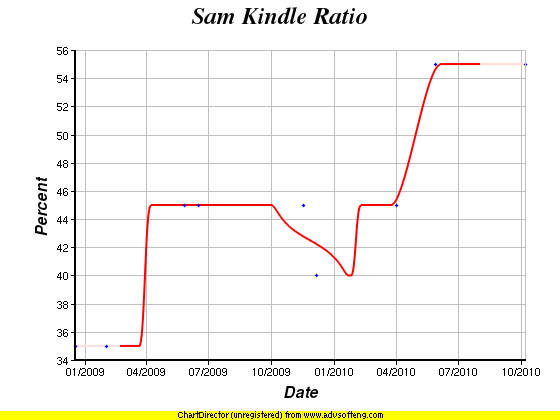
So, having finished a book lately, time for another updated Kindle ratio. (I did the counting a few days before actually getting the post done, thus this being the ratio for the 7th not the 10th.) This is basically what percentage of the last 20 books I have read are available on Kindle. Last time I updated this this percentage went over 50% for the first time, thus triggering my determination that I “officially wanted a Kindle”. There were a couple of books already in the queue though, but this meant that my method of determining what I read next would now be biased toward books available on Kindle, and the first time a Kindle book was scheduled, I would go ahead and order the Kindle. The book I finished prior to regenerating these stats was still a physical book though. As will be the next book finished. After that though, it has now been determined, a Kindle book. So the Kindle was ordered and is now in my hands. Woo! This means though that from this point forward my “Kindle Ratio” will be biased since my method of choosing books will be biased. It might still be interesting to see how long it takes this to get to 100% though, as my system does still allow me to pick non-Kindle books in several different situations. So for at least a little while, I’ll keep doing these updates. Until I get bored anyway. For now, we hold steady at 55%, or 11 out of the last 20 books I’ve read available on Kindle.
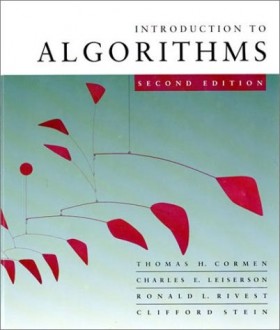
So, this was another book from my “to read for work” pile. The idea behind this one was to increase my technical depth in certain areas that might be helpful for me. The material in here was of course not all completely new. I’d covered some of it in 15-211 back at Carnegie Mellon, and even some at a Computer Science course at John’s Hopkin’s Center for Talented Youth when I was in high school. The difference of course was that in both of those, at least as far as I can remember them… it has been a long long time… the overview happened at a bit higher level, not diving as deep or getting as intensely into the proofs and such that this textbook does. Which brings up an important thing. This is indeed a textbook. It isn’t really intended to be “read” in the way I read it, sequentially from beginning to end, one page at a time. Ideally it is used in conjunction with an actual instructor led course and lectures. You might jump around in the book, spending lots of time on some areas, not much in others, and skipping others entirely. Reading straight through is a bit of a slog. 1180 pages of for the most part really dry and boring stuff. Now, to be clear, some of the material itself is kind of fun and interesting. I like thinking about algorithms and the ways in which those kind of things can work. But a textbook like this in isolation, without a course, without any multimedia, etc, and one that concentrates on the proving of theorems about the algorithms and such, just isn’t the most fun way to investigate these things. At least for me. (And this translates directly into my pretty sad 6.7 pages per day average rate for this book.) Time after time when reading about some new algorithm, I would bemoan the figures and diagrams in the book and think that my intuition of what was supposed to happen could be instantly jumpstarted if instead of the static diagrams and text there were engaging animations, perhaps with interactivity to change initial parameters and see how things were affected, etc. Instead, on any of the more complex ones, I would need to decide to either spend a decent amount of time slogging through log by line, or just decide it wasn’t worth it and move on. Now, I guess I know that the POINT is to slog through it line by line and figure it out. But still, getting the general concept across could happen so much more efficiently in other ways. But again, the goal here often is not getting the general concept across, but is rather in all the little details. Of course, some chapters were more fun than others. From my particular perspective, not that excited by sorts or data structures, or analysis techniques. Graph algorithms on the other hand are fun. I especially enjoyed the chapter on Maximum Flow. (Not that I have retained much, other than I found it interesting.) The number theory stuff is fun too. I thought I’d enjoy the NP-Completeness discussion as well, but in the end I really didn’t. Overall, it was a text book. So although there were bits that were interesting or piqued my interest, for the most part it was a chore to get through rather than something enjoyable. I really should get it through my head at some point that books like this are useful as reference, and most certainly as something augmenting an actual course… but reading books like this from beginning to end, one page at a time, definitely just kill my enjoyment of reading as an activity. Which isn’t to say there might not be others like this in my future. There will be. There are some on my list. But hopefully it will be a little while.
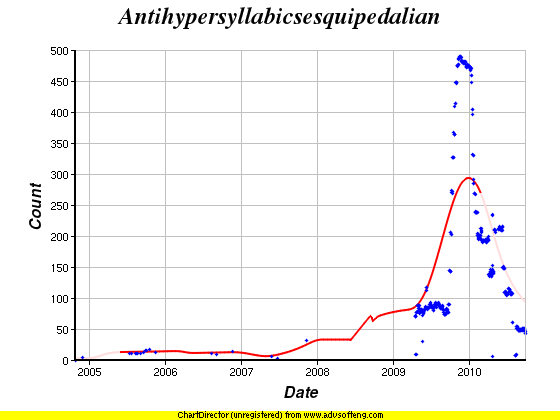
On October 26th 2004, I became, at least according to Google, the first one to use the word “antihypersyllabicsesquipedalian” on the web. That was this blog post where I talked about what the word meant and how I found out about it. Since then, as you can see on the chart above, usage of the word on the web (once again based on the number of Google search results) increased slowly from 2004 through 2009. But toward the end of 2009, a dramatic decline began. Now, I know that how Google reports the number of search results probably has a big effect on this, not just how often people are using the word. However, to combat this decline, more people have to use the word and use it more often. So, antihypersyllabicsesquipedalian… a person who hates long words… use it as often as you can!
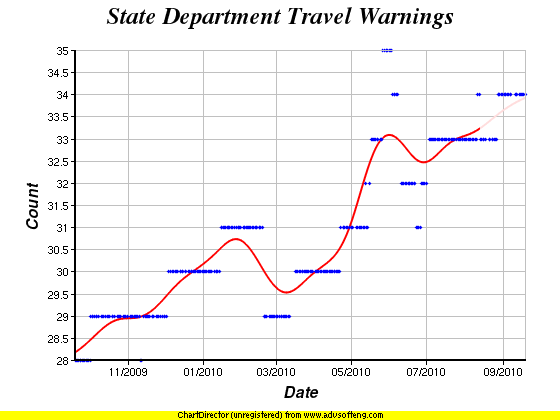
The chart above is the number of Current Travel Warnings from the US State Department over the last year. Just noting that the trend is upward. Of course, the trend has generally been upwards since the first time I looked at this back in 2004. Here is a chart showing that whole time period. Prior to 2009 though, I was only adding data very sporadically, for instance adding only 2 data points at all in the 2005-2008 time period. Since April 2009 though, I automated it to add one new data point every day, so the trends are much clearer. |
||||||||||