- Reading – Small plane with unconscious pilot sinks in Gulf (Douglas Stanglin) http://t.co/KaiExB0d #
- Reading – Romney's National Security Spokesman Is Openly Gay (Andrew Sullivan) http://t.co/j9zwB1Ly #
- Reading – The Hobbit May Change How We Watch Movies (Zeon Santos) http://t.co/L3bgGilJ #
- Reading – Melting Glaciers Liberate Ancient Microbes (Cheryl Katz and Daily Climate) http://t.co/BTGnvw0m #
- Reading – The Jetstar 'Texting While Landing' Incident, and the Cessna Descent Into the Gulf (James Fallows) http://t.co/t0e9OqX8 #
|
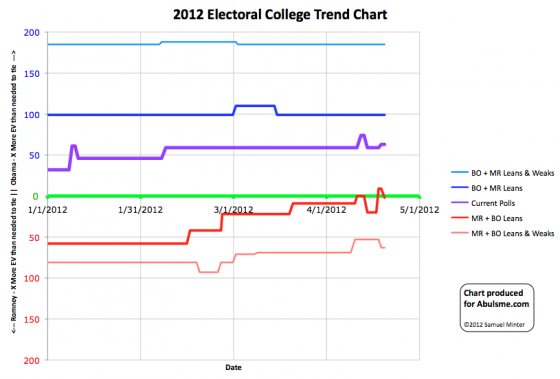
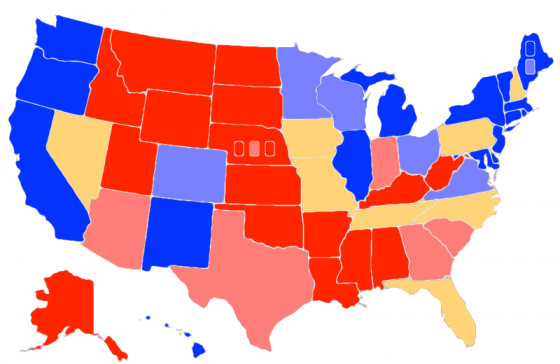
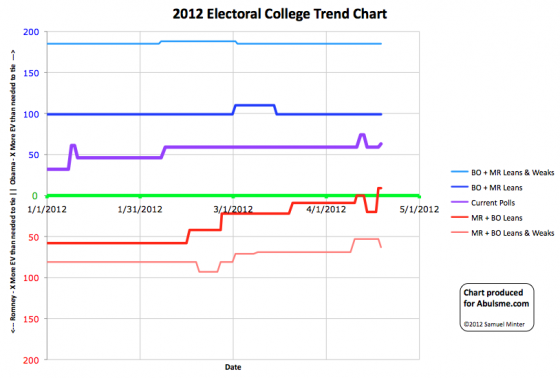
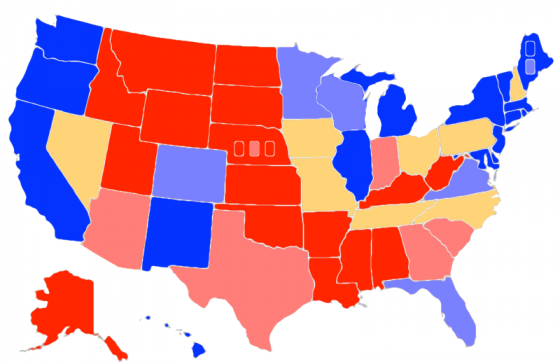
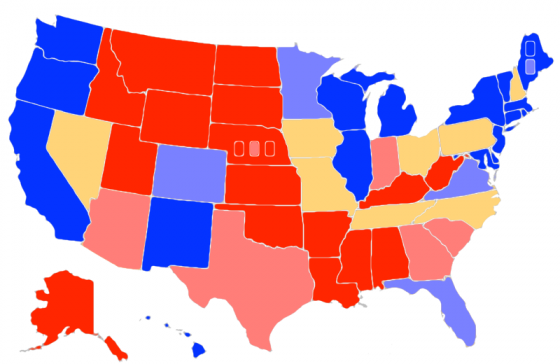
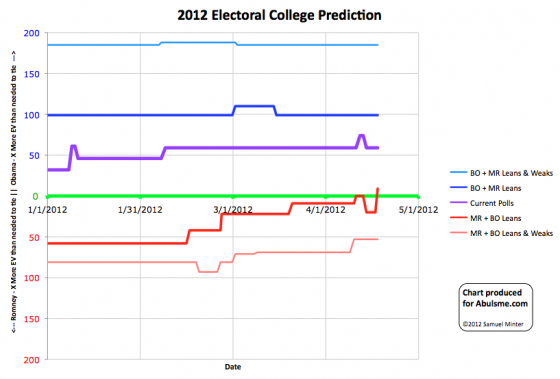
Chart and map from the Abulsme.com 2012 Electoral College Prediction page. Both assume Obama vs Romney with no strong third party candidate. Both show polling as it currently exists. Things will change before election day. Lines on the chart represent how many more electoral votes a candidate would have than is needed to tie under several different scenarios. Up is good for Obama, Down is good for Romney. On the map Red is Romney, Blue is Obama, Gold States are too close to call. Two changes today based on new polls added to my master spreadsheet. And they both change the inventory of swing states, so important changes at that! Here are the details: Florida (29 electoral votes): Just two days ago the five poll average moved Obama’s lead in Florida to over 5% (5.2%) and thus moved the state out of swing state status and into the “Weak Obama” category. Well, that didn’t last very long. Today’s update puts Obama’s 5-poll lead at 4.0%, so the state goes back into the “Lean Obama” category and is once again classified as a swing state for our model. Florida is big at 29 electoral votes, so makes a big difference in the electoral math. Ohio (18 electoral votes): Meanwhile, Obama’s lead in Ohio goes above 5% to 5.2% in the five poll average. This removes Ohio from the swing state pool and moves it into the “Weak Obama” group. This means Obama has a decent lead at the moment, but not so big that it wouldn’t be worth Romney’s time to try to attack that lead and pull Ohio back to being a close contest. Ohio is one of those states that everyone expects to be close, so don’t be surprised if, like Florida, Ohio doesn’t stay in this status too long. All and all since Florida is “worth more” than Ohio, today’s moves are good for Romney. And in fact, this once again makes it so if Romney wins all the swing states, he wins the election…
While some states have moved in both directions, if we look at all the changes in April so far, Obama is still in a better position than he was at the beginning of the month. We still haven’t had enough state polls to detect the recent move in Romney’s direction over the last week and a half. If Romney hold his position in the national polls, expect more states to move in Romney’s direction over the next few weeks.
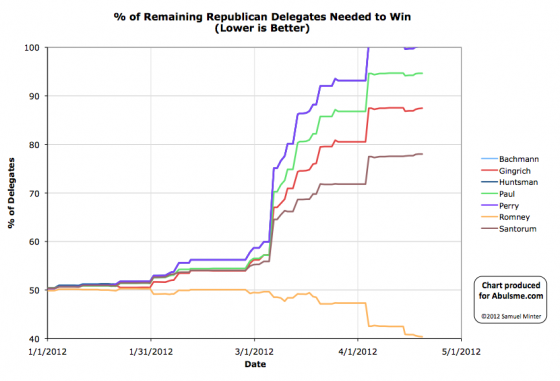
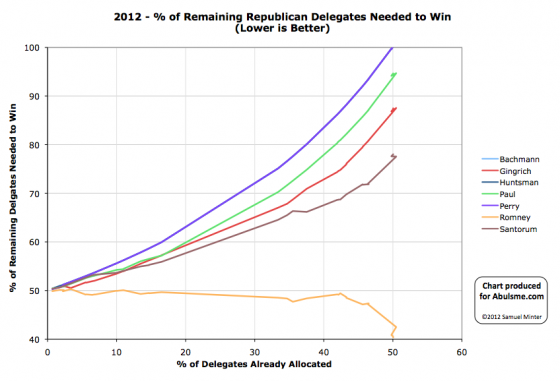
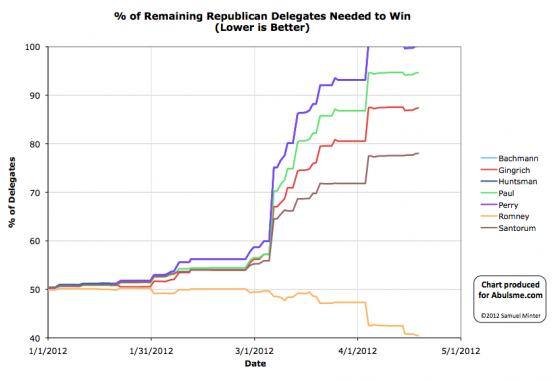
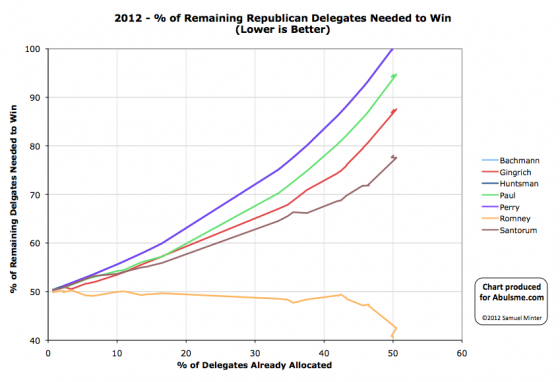
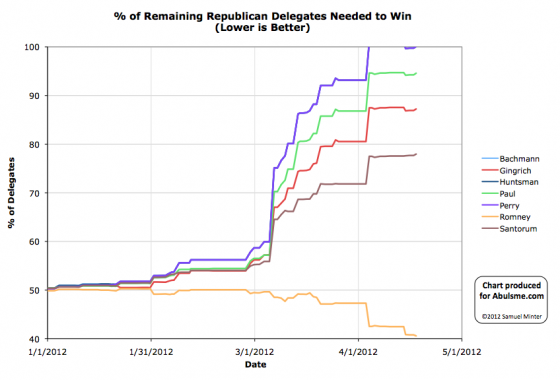
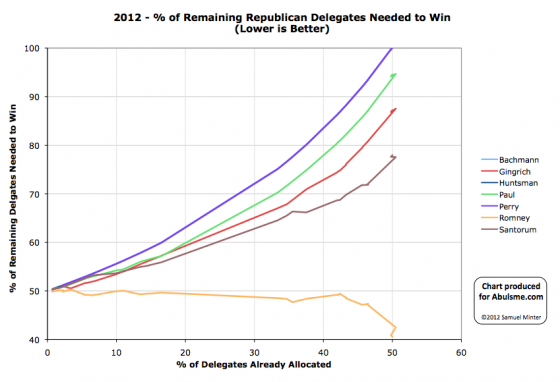
Charts from the Abulsme.com 2012 Republican Delegate Count Graphs page. When a candidate gets down to 0%, they have clinched the nomination. If they get above 100%, they have been mathematically eliminated. The first chart is by date, the second is by “% of Delegates Already Allocated”. These numbers include estimates of the eventual results of multi-stage caucus processes which will be refined as the later stages occur. Another minor update as Green Papers gets final delegate numbers from Tennessee. Back in March the results from the Primary were reported as Santorum 29, Romney 16, Gingrich 10. The final results turned out to be Santorum 29, Romney 17, Gingrich 9. So for the day: Romney +1, Gingrich -1 In terms of “% of remaining delegates needed to win”:
Can we please have some primaries again? This slow dripping of minor delegate changes is killing me. :-)
Chart and map from the Abulsme.com 2012 Electoral College Prediction page. Both assume Obama vs Romney with no strong third party candidate. Both show polling as it currently exists. Things will change before election day. Lines on the chart represent how many more electoral votes a candidate would have than is needed to tie under several different scenarios. Up is good for Obama, Down is good for Romney. On the map Red is Romney, Blue is Obama, Gold States are too close to call. Two changes in our poll classifications today based on new additions to our five poll averages. First, Obama’s lead in Wisconsin (10 electoral votes) drops to less than 10% bringing Wisconsin into the “Weak Obama” category. Since this is still not a swing state, our “Romney Best Case” scenario still doesn’t include Romney winning Wisconsin. But this does mean that Wisconsin is potentially in play. With the right combination of campaigning and events, Obama’s lead in Wisconsin could drop below 5%, putting it into contention as a swing state. It is not there today… Obama’s lead in the five poll average is still 8.8%… but it is close enough now to be worth spending time and money in the state. Second, New Hampshire (4 electoral votes) moves from being just barely Romney to being just barely Obama. (Obama’s lead in the five point average is 1.7%, which is negligible and can disappear in an instant.) New Hampshire remains too close to call and therefore one of our swing states. But this does change our “everybody wins the states they are ahead in” scenario.
Romney’s best case with current polling results remains a loss. And the “current status” improves for Obama because of New Hampshire. But Wisconsin does show there is some movement in Romney’s direction at the moment. Over the last eight days we’ve seen Obama’s lead in RCP’s National Poll average drop from 5,4% to 1.7%. That is a very significant drop. We’ll see over the next few weeks as more state polls come in whether this starts to translate into electoral college gains as well. The expectation is that as long as the national poll trend is sustained, the state numbers will move correspondingly as soon as we have enough state polls to show it. Edit 2012 Apr 19 07:10 UTC – Added number of electoral votes for each state mentioned. Edit 2012 May 30 15:47 UTC – It turns out New Hampshire’s move from Lean Romney to Lean Obama should actually have happened on Mar 31. Details of correction and revised historical chart posted on May 30.
Charts from the Abulsme.com 2012 Republican Delegate Count Graphs page. When a candidate gets down to 0%, they have clinched the nomination. If they get above 100%, they have been mathematically eliminated. The first chart is by date, the second is by “% of Delegates Already Allocated”. These numbers include estimates of the eventual results of multi-stage caucus processes which will be refined as the later stages occur. A couple minor updates today as we continue through the slow period before we have NY/PA/CT/RI/DE next week. The totals for Alabama get updated from Santorum 23, Gingrich 14, Romney 11, 2 TBD to Santorum 23, Gingrich 13, Romney 12, 2 TBD. This apparently after resolving a dispute on the results in the 7th congressional district. So Romney +1, Gingrich -1. Also, a superdelegate from Rhode Island endorsed Romney. So for the day, Romney +2, Gingrich -1. In terms of “% of remaining needed to win”:
I know. Yawn. But we will track this to the bitter end. Look for much bigger moves next week.
Map and chart from the Abulsme.com 2012 Electoral College Prediction page. Both assume Obama vs Romney with no strong third party candidate. Both show polling as it currently exists. Things will change before election day. On the map Red is Romney, Blue is Obama, Gold States are too close to call. Lines on the chart represent how many more electoral votes a candidate would have than is needed to tie under several different scenarios. Up is good for Obama, Down is good for Romney. Remember how a few days ago I said things were starting to improve for Romney? Well, that didn’t last long… Obama’s lead in the five poll average for Florida increases to over 5%. It leaves the swing states and moves to “Weak Obama”. My “best case scenarios” give one candidate or another all of the swing states. Florida makes a big difference. So what do things look like now?
Yes, that is right. With current state polling, if Romney wins ALL of the states that are close… He still LOSES 260 to 278. There are major caveats to give:
Despite this, it is remarkable for Obama to be showing this kind of lead. Romney has a lot of work to do. But wait…. haven’t there been polls in the news lately showing Romney ahead? What is going on? First, never pay attention to individual polls. Instead look at one of the places that aggregate. Lets look at RCP’s Average. Obama’s lead was usually between 4% and 6% from February until April. It was 5.3% on April 10th. It declined to 2.4% on April 14th. This dip is eight days old. Too short to be picked up in state polls. The projection here is consistent with the lead Obama showed until the last few days. If the new trend is sustained, it will show up in the state results soon. Second, the president is not elected by popular vote. It doesn’t matter if Obama is ahead in California by a little more or less. Obama will win California. But that will show up in national polls. Popular vote and electoral college will only diverge in close elections, but the election is decided by the electoral college. Look at the popular vote polls as leading indicators, but in the end, look at the electoral college. That is how Presidential elections work.
Charts from the Abulsme.com 2012 Republican Delegate Count Graphs page. When a candidate gets down to 0%, they have clinched the nomination. If they get above 100%, they have been mathematically eliminated. The first chart is by date, the second is by “% of Delegates Already Allocated”. These numbers include estimates of the eventual results of multi-stage caucus processes which will be refined as the later stages occur. Over the last week DCW counted four new Romney superdelegates. Two from New York, one from Colorado, and one from Connecticut. Four delegates is of course minor at this point and everybody knows the nominee is Romney, but we will continue posting updates until Romney actually gets to 1144. By the estimates I am using, he now has 680. In terms of “% of remaining needed to win” this update gives us:
This also puts us once again above 50% of the total delegates, which means anybody with no delegates at all is now once again eliminated absent the four candidates above losing delegates from their estimated totals (which can of course happen in various ways). So Bachman, Huntsman and Perrry… sorry about that. The rest of this post is a note for anybody interested in the nitty gritty details of how I come up with my counts. Everybody else can stop reading now. :-) When I started producing these charts in January I used Green Papers as my only delegate count source (specifically the soft count). Very soon after that I realized Green Papers wasn’t including super delegate endorsements, so I started adding in the superdelegate counts from DCW. Then a bit later on Green Papers started folding in the DCW numbers themselves, so I stopped separately adding them, and just used Green Papers count directly again. Sometimes there would be a day or two delay between DCW adding a Superdelegate and Green Papers incorporating that new information, but that wasn’t too bad. It seems like Green Papers is getting a bit further behind now though. As of this post they hadn’t yet added the superdelegates DCW added on the 11th, 12th and 16th. So I figure until they catch up, I’ll manually add the DCW numbers again. This update catches us up to DCW’s super delegate count and puts the Romney numbers here slightly ahead of what Green Papers is currently showing.
|
||||||||||||||||||||||||||||||||||||||