In the latest Curmudgeon’s Corner Sam and Ivan talk about:
Recorded on 15 Apr 2012 Length this week – 1:00:04 |
 |
|||||
|
||||||
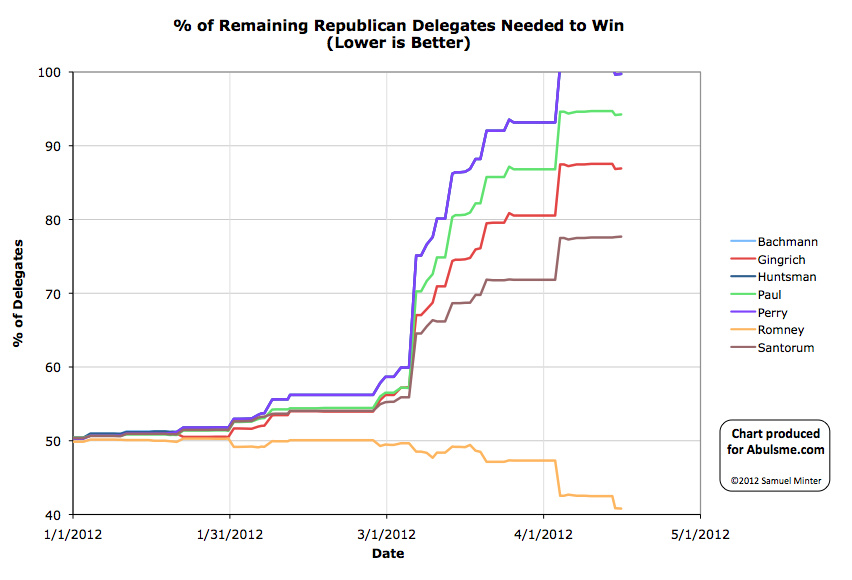
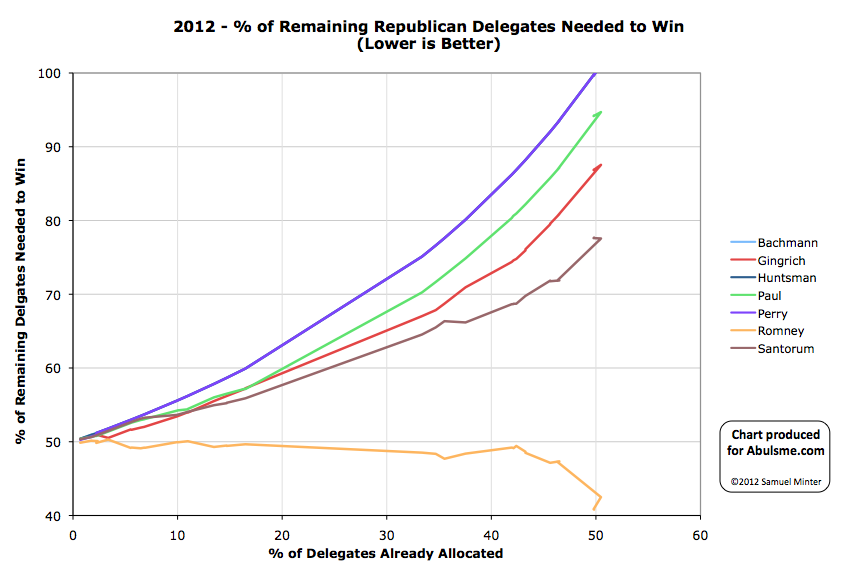
Charts from the Abulsme.com 2012 Republican Delegate Count Graphs page. When a candidate gets down to 0%, they have clinched the nomination. If they get above 100%, they have been mathematically eliminated. The first chart is by date, the second is by “% of Delegates Already Allocated”. These numbers include estimates of the eventual results of multi-stage caucus processes which will be refined as the later stages occur. Very shortly after my update yesterday, Green Papers updated their Wyoming soft count numbers again. They had been Romney 22, Santorum 2, Paul 1, and 4 TBD. They are now Romney 23, Santorum 2, Paul 1, and 3 TBD. So one of the uncommitted delegates moved to the Romney column. So Romney +1 delegate for the day. Very minor change. In terms of “% of remaining needed to win”:
I believe there are also two New York superdelegates that have come out for Romney that have been tracked by DCW that Green Papers hasn’t added to their totals yet. Since Green Papers now incorporates the DCW numbers, I don’t add them separately as I did in the early days. If I did I’d have to do a lot of extra tracking to avoid double counting, so I’ll wait for Green Papers to add them to their master soft count, which I expect will happen soon.
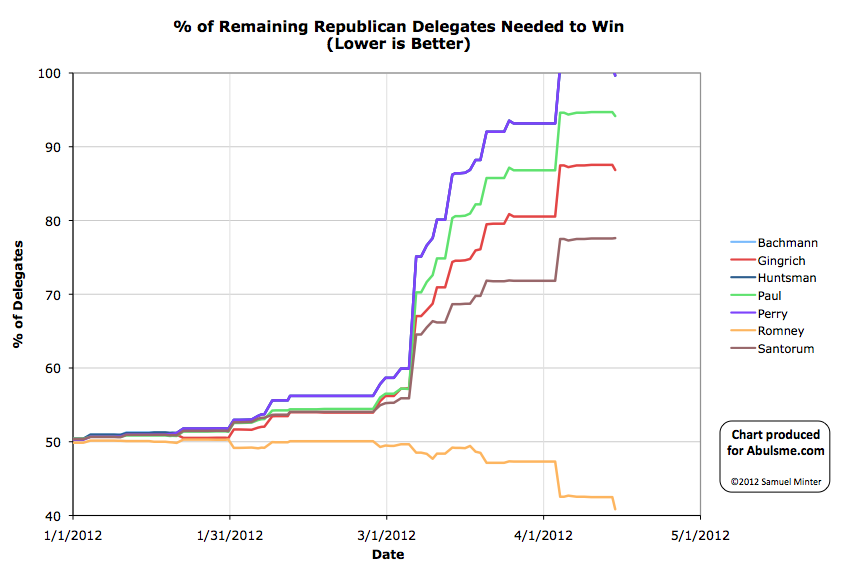
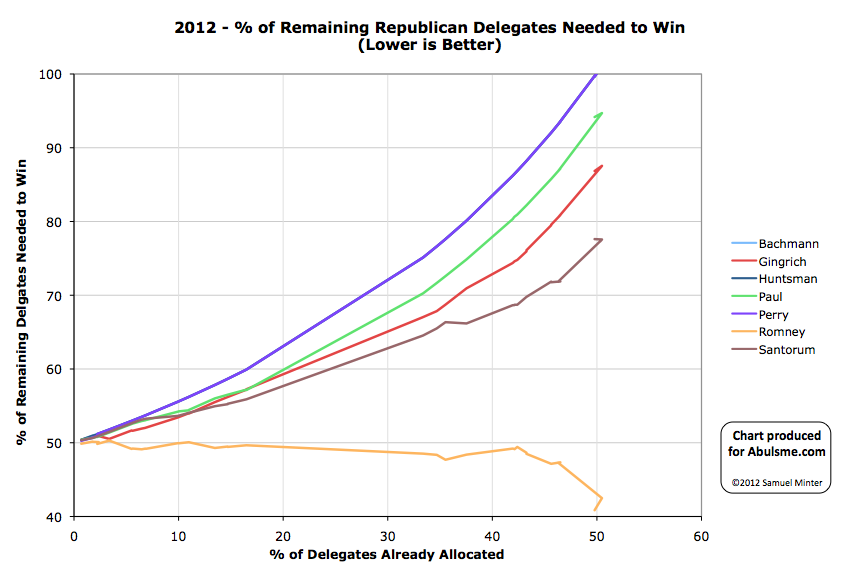
Charts from the Abulsme.com 2012 Republican Delegate Count Graphs page. When a candidate gets down to 0%, they have clinched the nomination. If they get above 100%, they have been mathematically eliminated. The first chart is by date, the second is by “% of Delegates Already Allocated”. These numbers include estimates of the eventual results of multi-stage caucus processes which will be refined as the later stages occur. Wyoming and Colorado both have caucus type delegate allocation systems, where local caucuses earlier in the year are actually just the start of multi-month multi-stage processes. Both Colorado and Wyoming had their state conventions this weekend finishing off the delegate selection in those states. Compared to the earlier estimates based on caucus results, the non-Romneys got crushed. Romney gained delegates. Everybody else lost delegates. This is not surprising. It is common for the “clear winner” to end up taking far more delegates in the end than it looked like they would given the “straw poll” results at the first stage. Looking more specifically…
Totaling the day we have Romney +12, Gingrich -6, Paul -9, Santorum -13. This does not look like a good day for the non-Romneys. Especially for Santorum. I guess dropping out of the race doesn’t help one’s ability to compete for delegates. Notice though that we actually lost 16 delegates from the totals as some delegates that were predicted to go for specific candidates ended up uncommitted to any candidate. This actually increases the pool of potentially available delegates. In theory this improves the situation slightly for Gingrich and Paul, because, hey, they might still convince those uncommitted delegates to vote for them. (And indeed, some reports say many of those uncommitted delegates aren’t ready to support anybody else yet, but are not for Romney at this point either.) Santorum lost enough delegates that his situation actually gets worse anyway. In terms of “% of remaining delegates needed to win”:
I should also mention, that having these additional 16 delegates not committed brings the total number of delegates allocated by the estimates we use (the Green Papers soft count) back under 50% of the total number of delegates. Which actually means that the candidates with no delegates right now (Bachman, Huntsman, Perry, random others) are now no longer mathematically eliminated, and could catch up and win by capturing 99.65% of the remaining delegates. If they were actually on the ballot on all of the remaining states. Which they are not. :-) So, uh, anyway… Romney still wins.
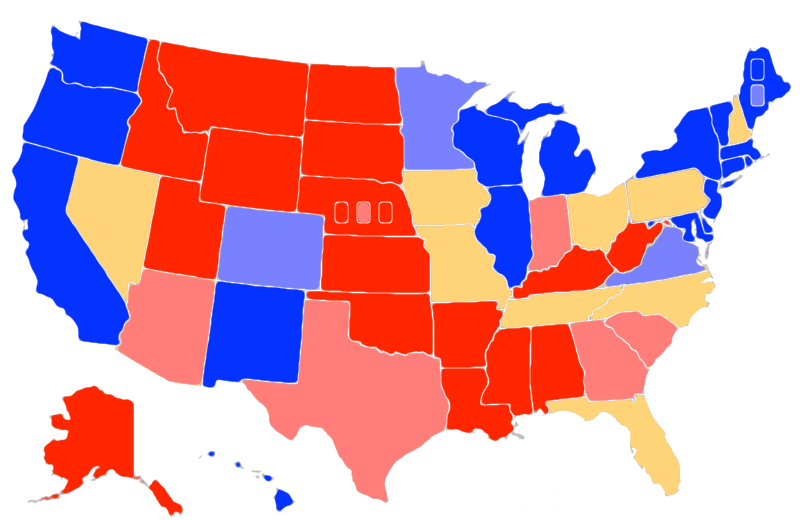
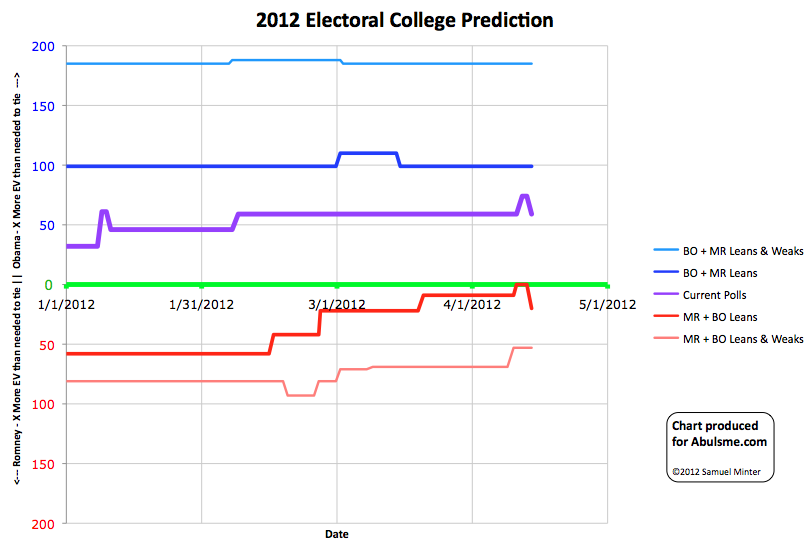
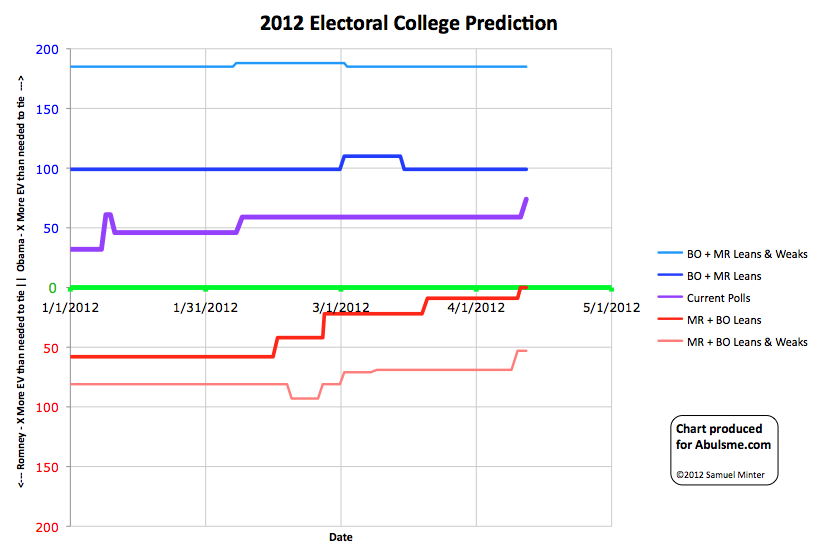
Map and chart from the Abulsme.com 2012 Electoral College Prediction page. Both assume Obama vs Romney with no third party strong enough to win states. Both show the polling situation as it currently exists. Things can and will change before election day. On the map Red is Romney, Blue is Obama, Gold States are too close to call. Lines on the chart represent how many more electoral votes a candidate would have than is needed to tie under several different scenarios. Up is good for Obama, Down is good for Romney. As we have been saying for the last few updates, at some point the trend making things look better and better for Obama would come to an end. Today is that day. Two states change categories. North Carolina: Only two days ago North Carolina moved from just barely Romney to just barely Obama in our five poll average. Well, a new poll there gets added today, and moves it back to just barely Romney. Easy come, easy go. In either case, it is really too close to call and counts as a swing state in our analysis. Pennsylvania: The five poll average prior to today had Obama up by 5.6% in Pennsylvania. Today’s update drops Obama’s lead to 4.4% in the five poll average, which takes the state out of “Weak Obama” territory and back into too close to call swing state status. (5% leads can disappear overnight given the right events after all.) The new summary becomes:
The “best cases” are when a candidate wins ALL the swing states, not just the ones they are ahead in. “Current Status” is if everybody wins the states they are even a tiny bit ahead in. Romney can once again win outright in his best case, not just tie and win in the House of Representatives. Trendwise though, these are the first moves in Romney’s direction in almost a month. (The last time was March 16th when Arizona moved from being a swing state to Weak Romney.) So the question of course is: Does that mean we have just passed Obama’s high water mark and Romney will continue gaining ground for awhile? My expectation is that we’ll have a bit more movement in Romney’s direction over the next few months as the general election is joined in earnest. This is natural as Romney is finally able to start crafting his general election message and, yes, moving toward “the center” to appeal to swing voters and swing states. Prior to a few days ago, he has had to concentrate on trying to get votes from Republicans… which is a very different game. We shall see soon enough I guess. :-)
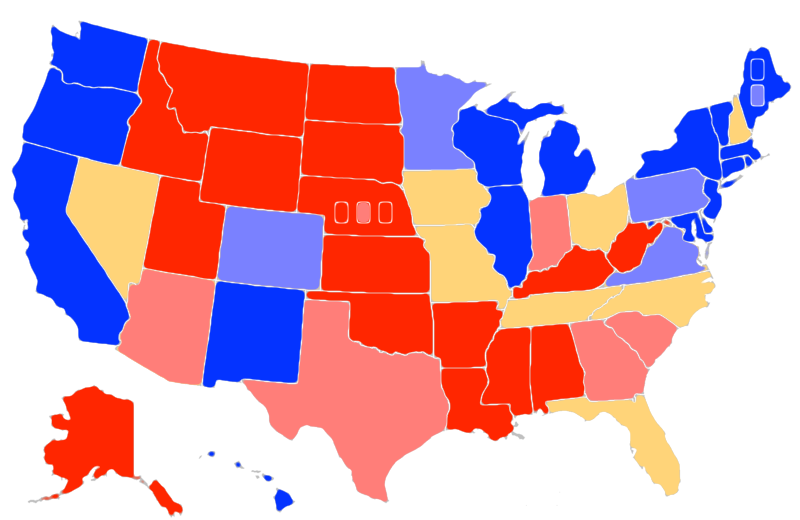
Map and chart from the Abulsme.com 2012 Electoral College Prediction page. Both assume Obama vs Romney with no third party strong enough to win states. Both show the polling situation as it currently exists. Things can and will change before election day. On the map Red is Romney, Blue is Obama, Gold States are too close to call. Lines on the chart represent how many more electoral votes a candidate would have than is needed to tie under several different scenarios. Up is good for Obama, Down is good for Romney. The latest polls move my five poll average in North Carolina from barely Romney to barely Obama. The reality is that the margin is still essentially too close to call (Obama ahead by 0.2%). North Carolina is firmly a swing state at the moment. So this doesn’t change the range of possibilities between Obama getting all swing states and Romney getting all swing states… but it does move our “everybody gets the states they are ahead in” line further toward Obama. In this case, we have Obama now winning 343 to 195. This is the third change in three days in Obama’s favor. The summary:
Edited 2012 Apr 12 21:24 UTC to replace an errant “McCain” with the intended “Romney”. Thanks JH for pointing out the error. |
||||||||||||||||||||||||||