This is the website of Abulsme Noibatno Itramne (also known as Sam Minter). Posts here are rare these days. For current stuff, follow me on Mastodon

Categories

Calendar

April 2026
S M T W T F S
 1234
567891011
12131415161718
19202122232425
2627282930  

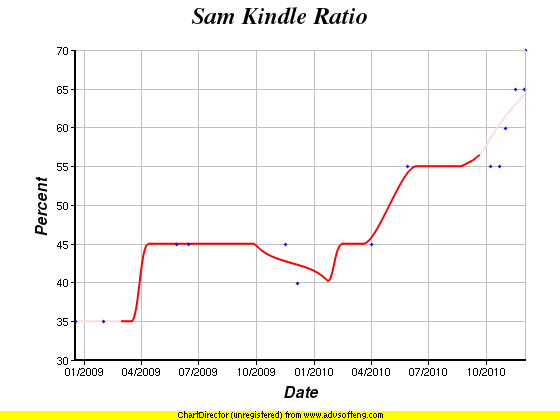
Kindle Ratio for 1 Dec 2010: 70%

Yet another update of the percentage of the last 20 books I have read which are available on Kindle as of right after I wrote the post about Shadow of the Hegemon. That book was available on Kindle, the one that fell off the 20 was not, and none of the ones in between changed status, so the percentage goes up from 65% to 70%. For reference:

  1. YES – Shadow of the Hegemon
  2. NO – The Visual Display of Quantitative Information
  3. YES – Ender’s Shadow
  4. YES – The Elegant Universe
  5. YES – Children of the Mind
  6. NO – Introduction to Algorithms
  7. YES – Xenocide
  8. YES – The Geography of Bliss
  9. YES – Speaker for the Dead
  10. NO – First Break all the Rules
  11. YES – Ender’s Game
  12. YES – Until the Sea Shall Free Them
  13. YES – Foucoult’s Pendulum
  14. YES – Java The Complete Reference
  15. NO – Harry Potter and the Deathly Hallows
  16. YES – The Audacity of Hope
  17. NO – Harry Potter and the Half-Blood Prince
  18. NO – Data Mining
  19. YES – The Children of Hurin
  20. YES – Dreams from my Father

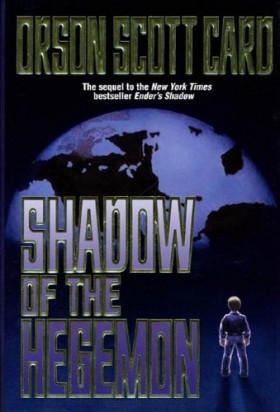
Shadow of the Hegemon

Author: Orson Scott Card
Original Publication: 2001
Started: 2010 Oct 30
Finished : 2010 Nov 8
Format: Kindle
7231 locations / 10 days
723 locations / day

So here I go, I am now up to Book 6 in the Ender Series. This book once again concentrates on the character of Bean, the minor character in Ender’s Game that got a deeper background in the last book, Ender’s Shadow. Now that the Buggers / Formics have been defeated, the action shifts back to Earth, where the unity of the planet during the war against an alien threat has fallen apart, and now major geopolitical shifts are under way as national powers start reasserting themselves.

In this context, the former members of Ender’s team (including Bean) become major players, as they are considered the brightest military minds on the planet. An old rival of Bean’s from his childhood who was introduced in the last book also plays a huge part as the villain, constantly plotting for his own power, but more importantly for revenge against all those, such as Bean, who had ever seen him in positions of weakness.

There is some interesting geopolitical speculation here, looking at how a world might look several hundred years in our future, after an interlude where the planet had been forced to unite, but no longer is. But even given the premise of this cadre of super-bright children who had already saved the world, it does start to stretch the suspension of disbelief a little bit when you essentially get a handful of teenagers engaging in machinations that direct the course of major nations as they go into and out of war. It is an entertaining story, and once again Card is doing a novel that concentrates on events and actions as opposed to philosophical speculation. They are different sorts of novels. Both good in their own way.

This is maybe in the middle of the pack of the series so far in terms of how much I’ve enjoyed it. Not as good as #1, #2 or #5 in this series, but probably better than #3 and #4. Dunno. They are all enough different from each other that it is hard to compare.

Worth a read if you like this series. I wouldn’t suggest picking it up without having read at least #5 though, since it follows directly on from that book.

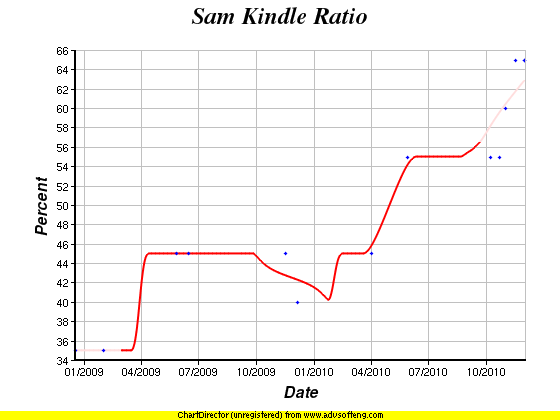
Kindle Ratio for 29 Nov 2010: 65%

So, yet another update of the percentage of the last 20 books I’ve read that are available on Kindle as of soon after I posted about The Visual Display of Quantitative Information. The book that fell off was not available, neither was the one I just added, and none of the ones in between changed status, so the metric stayed at 65%.

  1. NO – The Visual Display of Quantitative Information
  2. YES – Ender’s Shadow
  3. YES – The Elegant Universe
  4. YES – Children of the Mind
  5. NO – Introduction to Algorithms
  6. YES – Xenocide
  7. YES – The Geography of Bliss
  8. YES – Speaker for the Dead
  9. NO – First Break all the Rules
  10. YES – Ender’s Game
  11. YES – Until the Sea Shall Free Them
  12. YES – Foucoult’s Pendulum
  13. YES – Java The Complete Reference
  14. NO – Harry Potter and the Deathly Hallows
  15. YES – The Audacity of Hope
  16. NO – Harry Potter and the Half-Blood Prince
  17. NO – Data Mining
  18. YES – The Children of Hurin
  19. YES – Dreams from my Father
  20. NO – The Odyssey

I’ll note as I have the last few times that other editions of The Odyssey are available on Kindle, just not the specific edition I read.

Amy and the Cherry Tree

[tube]xn6ZqHPu-Mg[/tube]

Goodbye Maxima

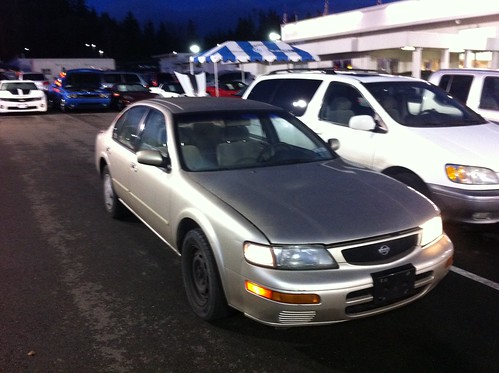
We had to take one last drive in the Maxima since to get the trade in it had to drive into the dealer’s lot. This is a picture right as Brandy was handing over the keys. Seconds earlier it had been billowing thick clouds of white smoke. But it made it!

Brandy’s Passat

Done. She will be driving it home momentarily.

Car Transition

Looks like Brandy’s 1995 Nissan Maxima with 246k miles on it now needs an expensive repair that may or may not actually completely fix the problem. If it doesn’t fix it then actually fixing it would most likely cost significantly more than the car is worth.

So we are car shopping. Right now Brandy is looking at a 2007 Volkswagen Passat 2.0T Wagon and is really excited about it. Test drive coming after we eat lunch. If she likes it we may end up with it. We shall see.
I Hit the Computer with my Fist

In the latest Curmudgeon’s Corner…

Sam and Ivan talk about:

  • Hawaiian Vacations
  • Upgrades and Backups
  • Silly TSA
  • Windows 1.0
  • Windows Stores
  • Windows Phone

Just click to listen now:

[wpaudio url=”http://www.abulsme.com/CurmudgeonsCorner/CC20101121.mp3″ text=”Recorded 21 Nov 2010″]

or

1-Click Subscribe in iTunes

View Podcast in iTunes

View XML Feed

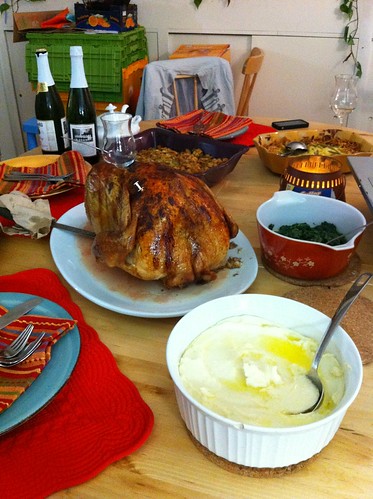
Happy Turkey!

Well, not that happy a turkey, since we’re about to eat it. Oh well!

The Visual Display of Quantitative Information: Second Edition

Author: Edward R. Tufte
Original Publication: 2001
Started: 2010 Oct 24
Finished : 2010 Oct 30
Format: Hardcover
197 pages / 7 days
28.1 pages / day

So, back to a physical book again. This one was part of the spoils from going to Tufte’s Lecture back in June. All the attendees got his four major books, of which this, The Visual Display of Quantitative Information is the first. Since I went to the lecture for work, this is on my work non-fiction list.

Of course, I’d seen this book around and heard about it for many many years. I remember talking to colleagues about this book way back when I first started doing web and internet related stuff in the 90’s. That would have been the first edition of course. What I read now is the second edition, but I gather the changes were more in terms of corrections and improvements to images and such, rather than fundamental changes to the content.

Tufte’s books been, and especially this one, have been held up essentially as bibles for good visual information design. Having now seen his lecture and read the first of his books, my initial impression is that while he certainly makes a number of good points, especially when it comes to things that are routinely done badly and which should be avoided, he falls down a bit in terms of his positive suggestions for new sorts of presentations. It seems that perhaps he is a little overhyped. Of course, there is also the possibility that it only seems that way because many of his recommendations have become so widely regarded over the years that when you hear them now you think “Well, duh! How could anyone think otherwise?” whereas when he first articulated his ideas they were a brand new perspective. I think this is quite likely.

Of course, his major complaint is with information graphics that are full of what he calls “chart junk” or misrepresentations. Basically decorative elements that add no information and often detract from understanding the data, or choices of graphical treatment that leave a casual viewer with an incorrect impression of the data. He gives many examples of these sorts of bad usages. The core message is to strip away the extraneous elements and concentrate on the data itself, and then be extremely careful to show that data in a way that highlights the important aspects of the data honestly. This is excellent core advice.

He does get a little too sparse in some cases though, or recommends presentations that he himself says may stray into “puzzle” territory, where the person looking at the chart has to figure out what some of the new conventions mean. I suppose some of this just has to do with being used to the standard conventions. But in some cases I think it is just a case of taking good general principles a bit too far. For instance, remove the frame and gridlines around many plots. Now, certainly gridlines should be light enough to not interfere with looking at the data, but I like having them damn it, and the frame separates out the data from whatever is surrounding it. Yes, I get they may not be completely necessary, but I actually think they help in many cases.

Oh, and of course Tufte introduced sparklines. These can be useful in certain contexts, but I generally don’t like them.

There. I got my curmudgeonly bit out.

In any case, this is a classic on these topics, and well worth reading. Even if you don’t buy into every last bit of what Tufte is saying, the general principles are right on the money and worth considering whenever you are trying to present any quantitative data graphically.